
Lean Warehousing: The Complete Guide to Principles, 5S, and Layout Optimization (UAE 2026)
Learn lean warehousing principles, 5S, Kaizen & JIT to cut waste, optimize layout & storage density. Practical guide for UAE warehouses by RackPro
Every square meter of unused warehouse space, every extra step a picker takes, and every pallet stuck in the wrong location is quietly costing your business money. Lean warehousing is the discipline that fixes this — a proven approach to running a warehouse that eliminates waste, tightens up layout, and gets more output from the space you already have.
For UAE warehouse operators facing rising rental costs across Dubai, Abu Dhabi, and Sharjah, lean warehousing isn’t a theoretical concept — it’s often the difference between leasing a second facility and simply reorganizing the one you have. This guide breaks down exactly what lean warehousing means, the core principles behind it, and how to put it into practice, with a specific focus on the one variable that determines whether any of it works: your racking and layout.
What Is Lean Warehousing?
Lean warehouse management is the practice of running warehouse operations with the least possible waste — of space, time, motion, and materials — while maintaining or improving output and service levels. The concept is adapted from lean manufacturing, most famously developed by Toyota, and applied to receiving, storage, picking, packing, and shipping processes.
In simple terms: lean warehousing asks one question of every activity in your warehouse — does this add value for the customer, or is it just consuming resources? If an activity doesn’t add value, lean methodology treats it as waste to be reduced or removed.
This matters more in the UAE than in most markets. Warehouse rents in prime logistics zones have climbed steadily, and expansion isn’t always an option — especially for businesses in industrial areas like Musaffah, Jebel Ali, or Al Quoz where available plots are limited. Lean warehousing principles let you increase capacity and throughput inside your existing footprint instead of paying for more square footage.
Lean Warehousing vs. Traditional Warehousing
It helps to see the contrast side by side:
Traditional Warehousing
Lean Warehousing
Storage planned around available space
Storage planned around product velocity and value
Inventory held “just in case”
Inventory held “just in time,” based on real demand
Layout rarely reviewed after setup
Layout continuously audited and adjusted
Waste treated as a cost of doing business
Waste actively identified and eliminated
Racking chosen once and left as-is
Racking system matched and re-matched to changing SKU profiles
The core difference: traditional warehousing manages space. Lean warehousing manages value — and treats space, labor, and inventory as resources that must justify themselves.
The Origins: Muda, Muri, and Mura
Lean methodology is built on identifying three types of operational waste, using their original Japanese terms from the Toyota Production System:
✓ Muda (waste) – any activity that consumes resources without adding value. In a warehouse, this shows up as excess inventory, unnecessary motion, overproduction of picked orders, defects, and wasted transport between zones.
✓ Muri (overburden) – overloading people, equipment, or racking beyond safe or efficient capacity. An overloaded pallet racking bay or a picker assigned an unrealistic workload both fall under muri.
✓ Mura (unevenness) – inconsistency in workflow, such as demand spikes that overwhelm staff one week and leave them idle the next.
Understanding these three categories is the starting point for any lean warehousing principles you apply — you’re always working to reduce muda, prevent muri, and smooth out mura.
The 5S Methodology in Warehousing
The 5S methodology is the most widely used framework for implementing lean warehousing principles on the floor. Each “S” is a stage, and together they build a warehouse that stays organized rather than sliding back into clutter.
01
Sort (Seiri)
Go through every item, tool, and piece of equipment in the warehouse and separate what is genuinely needed from what isn’t. Obsolete stock, broken pallets, and unused equipment get removed or relocated. This is also the point to flag slow-moving SKUs that are eating up prime racking positions they don’t deserve.
02
Set in Order (Seiton)
Every item gets a defined, logical location — this is where warehouse slotting strategy comes in. Fast-moving SKUs go to the most accessible positions (typically ground-level or golden-zone beam levels), while slow movers go higher or further back. This single step is usually where racking configuration has the biggest impact on lean outcomes.
03
Shine (Seiso)
Keep the warehouse and racking system clean and well-maintained. This isn’t just cosmetic — a clean, well-lit warehouse makes it far easier to spot damaged racking components, spills, or safety hazards before they cause downtime or accidents.
04
Standardize (Seiketsu)
Turn the first three S’s into repeatable standard operating procedures — labelling conventions, restocking rules, inspection schedules — so the system doesn’t depend on any one person’s memory.
05
Sustain (Shitsuke)
Build the discipline and audit cadence to keep the first four S’s alive long-term. Regular walkthroughs, scheduled racking inspections, and refresher training all fall under this stage.
If you’re wondering how to implement 5S in a warehouse without disrupting operations, the practical answer is to run it zone by zone rather than facility-wide, starting with your highest-traffic aisle so the impact is visible fast.
Kaizen: Continuous Improvement in Warehouse Management
Kaizen warehouse management is the ongoing half of lean warehousing — the commitment to small, continuous improvements rather than one-off overhauls. Where 5S gives you a structured starting point, Kaizen keeps the system evolving as order volumes, SKU mixes, and seasonal demand change.
In practice, Kaizen in a warehouse looks like:
- Weekly or monthly floor audits to catch new inefficiencies
- Front-line staff empowered to flag problems and suggest fixes, since pickers and forklift operators usually spot layout issues before management does
- Small layout or slotting adjustments made incrementally, instead of waiting for an annual redesign
Just-In-Time (JIT) Inventory in Warehousing
Just-in-time inventory management is a core pillar of lean warehousing. Rather than stockpiling inventory “just in case” demand appears, JIT aligns incoming stock closely with actual, forecasted demand. The benefits compound quickly:
- Lower carrying costs and less capital tied up in stock sitting on racking
- Reduced risk of obsolete or expired inventory
- Freed-up racking positions for genuinely active SKUs
JIT does place more precision demands on your storage system — you need racking flexible enough to absorb frequent small receipts rather than bulk deliveries, which is one reason selective pallet racking often outperforms high-density systems in JIT-driven operations.
Value Stream Mapping for Warehouses
Value stream mapping is the diagnostic tool lean warehousing uses to see waste clearly. It involves physically mapping every step a product takes from the moment it arrives at your dock to the moment it ships — receiving, put-away, storage, picking, packing, and dispatch — and marking which steps add value and which don’t.
Common findings from a warehouse value stream map include:
- Pickers walking excessive distances between fast-moving SKUs stored far apart
- Double-handling caused by inadequate staging space
- Bottlenecks at put-away because racking access points are poorly positioned relative to the receiving dock
Once mapped, these waste points become the priority list for your next layout or racking adjustment.
Warehouse Layout Design: Where Lean Warehousing Lives or Dies
You can apply every lean principle above, but if your warehouse layout design works against you, results will always be limited. Layout is the physical infrastructure that either enables or blocks lean warehousing.
Key layout considerations for a lean warehouse:
✓ Flow-based design – receiving, storage, picking, and dispatch zones arranged in a logical sequence that minimizes backtracking
✓ Aisle width matched to equipment – narrower aisles increase storage density but require compatible forklifts or VNA equipment; the wrong combination creates bottlenecks instead of savings
✓ Golden zone placement – the most ergonomic, fastest-to-access shelf and beam levels reserved for your highest-velocity SKUs
✓ Clear, consistent labelling and signage – to support the “Set in Order” stage of 5S
Warehouse Space Optimization and Storage Density
Warehouse space optimization and warehouse storage density are often where lean warehousing delivers its most measurable ROI, because they directly determine whether you need to lease additional space at all.
Practical levers for improving density without sacrificing accessibility:
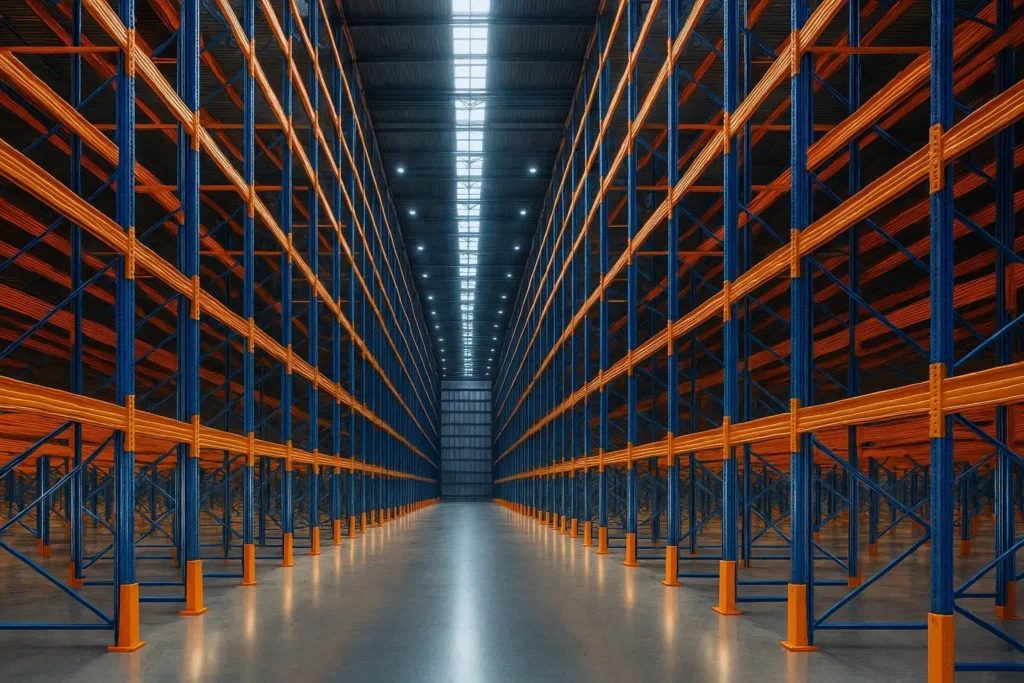
✓ Vertical storage optimization – using the full height of your facility instead of just the floor footprint. Heavy-duty pallet racking that reaches your ceiling clearance safely can often double effective storage capacity without adding a single square meter of floor space.
✓ High-density racking systems – drive-in racking and VNA (Very Narrow Aisle) racking systems reduce aisle space and increase pallet positions per square meter, which is particularly valuable in high-rent UAE industrial zones.
✓ Specialized storage for irregular loads – cantilever racking frees up standard pallet positions by giving long or bulky items (pipes, timber, steel) their own dedicated, space-efficient storage, rather than letting them consume oversized pallet bays.
Choosing the right combination of these systems is a warehouse-specific decision — it depends on SKU velocity, pallet turnover, and available headroom, which is why a layout audit should come before any racking purchase.
Warehouse Slotting Strategy
Warehouse slotting is the practice of assigning specific storage locations to specific SKUs based on data — velocity, size, weight, and pick frequency — rather than habit or convenience. A sound slotting strategy typically applies ABC analysis:
✓ A items – (highest velocity): closest to dispatch, at accessible beam or shelf heights
✓ B items – (moderate velocity): mid-zone placement
✓ C items – (slow-moving): higher racking levels or less accessible zones
Re-slotting isn’t a one-time project — as your SKU mix shifts seasonally, your slotting plan should shift with it. This is a recurring Kaizen activity, not a set-and-forget task.
Benefits of Lean Warehousing
The benefits of lean warehousing extend well beyond a tidier floor:
✓ Lower operating costs – less wasted space, less wasted labor, less excess inventory carrying cost
✓ Higher storage density – more pallet positions and SKUs within the same footprint, often removing the need to lease additional warehouse space
✓ Faster order fulfillment – reduced picker travel time and fewer bottlenecks
✓ Improved safety – decluttered aisles, properly loaded racking, and clear walkways reduce workplace incidents
✓ Better inventory accuracy – organized, standardized storage locations make cycle counts faster and more reliable
✓ Greater scalability – a lean, well-slotted warehouse absorbs growth without needing a full redesign
Choosing the right combination of these systems is a warehouse-specific decision — it depends on SKU velocity, pallet turnover, and available headroom, which is why a layout audit should come before any racking purchase.
Lean Warehouse Examples in Practice
A few realistic lean warehouse examples relevant to UAE operations:
- A distribution center reorganizes its fastest-moving beverage SKUs into drive-in racking near the loading dock, cutting picker travel time and freeing up selective racking elsewhere for slower, more varied stock.
- A retail backroom facility applies 5S to remove obsolete stock and re-slots remaining inventory by sales velocity, reclaiming enough space to avoid renting a second unit.
- A manufacturing facility installs cantilever racking for long steel stock that was previously stored on the floor, immediately freeing an entire aisle for standard pallet positions.
In each case, the improvement isn’t a new building — it’s a smarter match between inventory, layout, and racking.
Warehouse KPIs and Performance Metrics for Lean Operations
You can’t manage what you don’t measure. Common warehouse KPIs used to track lean warehousing progress include:
✓ Storage utilization rate – percentage of available pallet/shelf positions actively in use
✓ Order picking accuracy – percentage of orders picked without error
✓ Average picker travel distance – a direct indicator of layout and slotting efficiency
✓ Inventory turnover rate – how quickly stock moves through the facility
✓ Dock-to-stock time – how long it takes goods to move from receiving to a stored, retrievable location
✓ Racking utilization by zone – identifies underused or overloaded racking areas
Tracking these consistently turns lean warehousing from a one-time initiative into a measurable, ongoing operating standard.
Lean Warehouse Best Practices for Implementation
If you’re starting from scratch, these lean warehouse best practices keep implementation manageable:
✓ Audit before you act – Map your current layout, storage utilization, and pick paths before changing anything.
✓ Start with 5S in one zone – Prove the concept in a single high-traffic aisle before rolling out facility-wide.
✓ Match racking to SKU behavior – not the other way around — don’t force your inventory to fit whatever racking is already installed.
✓ Involve floor staff early – Pickers and forklift operators see inefficiencies management doesn’t.
✓ Set a Kaizen cadence – Monthly reviews are enough to catch drift before it becomes a full redesign project.
✓ Reassess racking, not just process – Many “process” problems are actually layout or racking-configuration problems in disguise.
How Racking Choice Determines Lean Warehousing Success
This is the point most lean warehousing guides skip: your racking system is not a fixed backdrop to lean warehousing — it’s one of the biggest levers you have. The best slotting strategy in the world can’t overcome racking that doesn’t match your pallet dimensions, load weights, or turnover patterns.
High SKU variety with moderate turnover → heavy-duty selective pallet racking for direct access to every position
High-volume, single-SKU storage (beverages, FMCG) → drive-in pallet racking for maximum density
Space-constrained facilities needing more positions per square meter → VNA racking systems
Long, bulky, or irregular items (pipes, timber, steel) → cantilever racking to free up standard pallet bays
A lean warehousing initiative that starts with a proper racking and layout audit — rather than jumping straight to labelling and 5S posters — is the one that actually delivers measurable space and cost savings.
Frequently Asked Questions
The main goal is to eliminate activities that consume resources without adding value — excess space, motion, inventory, and time — while maintaining or improving service levels and output.
Lean warehousing is the overall philosophy of waste reduction; 5S is one specific, structured method used to implement it on the warehouse floor.
No. While automation can support lean principles, most lean warehousing gains — better slotting, correct racking selection, 5S discipline — come from process and layout changes, not technology investment.
Most operations benefit from reviewing slotting quarterly, or sooner if there's a significant seasonal shift in SKU velocity.
Yes. Vertical storage optimization, higher-density racking systems, and better slotting frequently reclaim enough capacity to delay or avoid leasing additional space — a major advantage in high-rent UAE industrial zones.
Ready to Apply Lean Warehousing to Your Facility?
Lean principles only work as well as the racking system behind them. RackPro Shelving designs, supplies, and installs pallet racking, drive-in, VNA, and cantilever systems engineered around your actual SKU profile and warehouse layout — not the other way around. Get in touch with our team for a layout and racking audit tailored to your UAE facility.