
Cross Docking Explained: Types, Benefits & Warehouse Layout Guide
Cross docking explained — definition, types, benefits, and how the right warehouse layout and racking make a cross dock facility actually work.
What Is Cross Docking? A Complete Guide to Types, Benefits & Warehouse Layout
Storage costs money every single day a product sits on a shelf. Rent, insurance, handling, and the labor to move it in and out all add up — and for a growing number of businesses, the smartest move isn’t better storage. It’s skipping storage altogether.
That’s the entire premise behind cross docking: goods arrive, get sorted, and leave again within hours, sometimes minutes, with little or no warehousing in between. This guide covers what cross docking actually means, the different types used across industries, its benefits over traditional warehousing, and — the part most guides skip — what your warehouse layout and racking actually need to look like to make it work.
What Is Cross Docking?
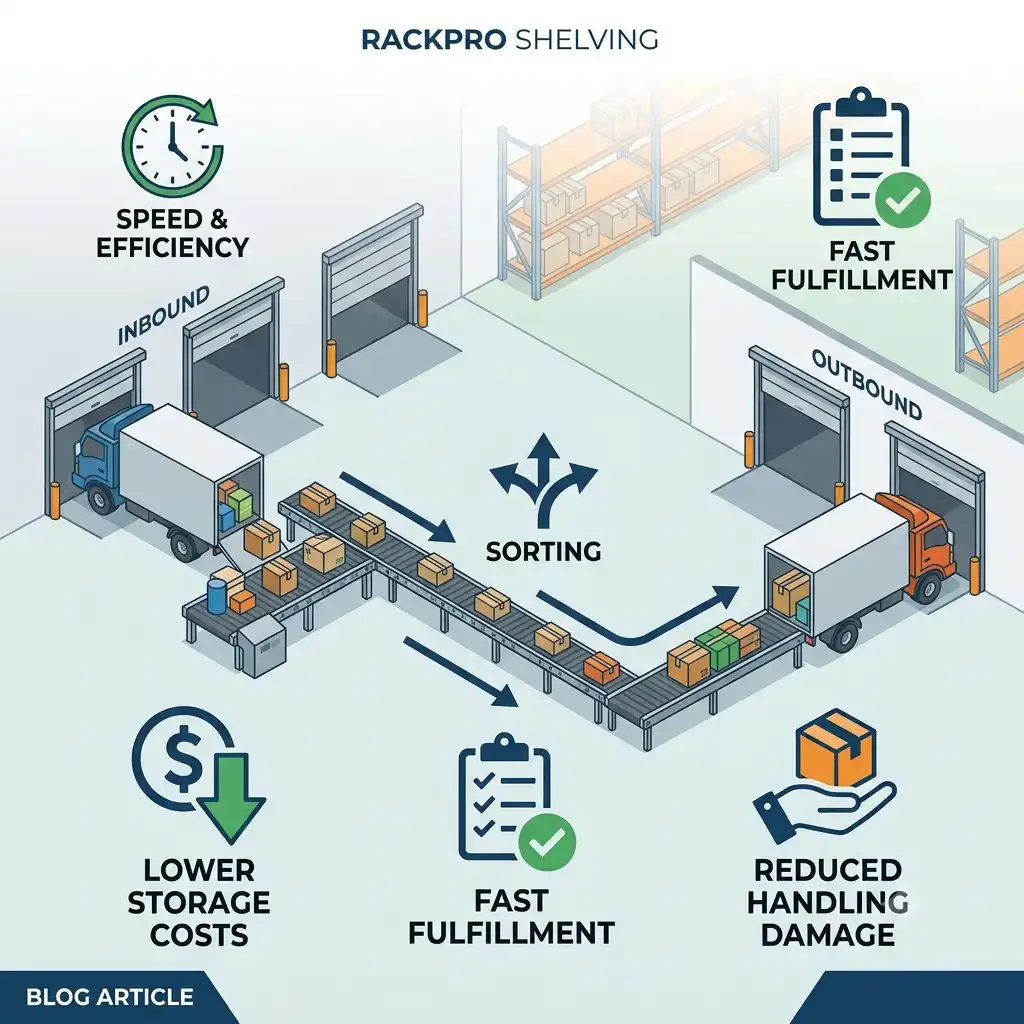
Cross docking meaning, in simple terms: it’s a logistics strategy where inbound goods are unloaded from an incoming truck, sorted, and immediately reloaded onto outbound transport, with minimal or no storage time in between.
Cross docking definition more formally: a distribution method in which products move directly from receiving to shipping, “crossing the dock” at a facility built for fast sortation and transfer rather than long-term storage.
Instead of goods sitting in racking for days or weeks waiting to be picked, a cross-docking operation is built around speed — products typically arrive in the morning and are out the door by afternoon.
How Cross Docking Works
01
02
03
Items are sorted and consolidated based on their final destination
04
Sorted goods are moved directly to outbound trucks at shipping doors
05
Outbound transport departs, often within hours of the original delivery
The cross dock terminal itself is usually designed as a long, narrow building with dock doors lining both sides — inbound trucks on one side, outbound on the other — so goods can move straight across the facility with minimal travel distance.
Types of Cross Docking
Not all cross-docking operations work the same way. The method used depends on the industry and the shape of the inbound and outbound shipments.
Goods are already assigned to a specific customer or destination before they even arrive at the facility. The cross dock simply sorts and reroutes them onto the correct outbound truck.
Goods arrive without a pre-set destination. They’re received into the facility first, then sorted and consolidated based on real-time demand or store orders before being shipped out — giving businesses more flexibility to adjust routing on the fly.
The reverse process — large inbound shipments are broken down into smaller loads for distribution to multiple destinations, common in retail chains receiving bulk deliveries for multiple stores.
Goods move through the facility in a constant, ongoing flow rather than in scheduled batches, typically used in high-volume, time-sensitive operations.
Retailers receive products from multiple suppliers and immediately sort them for delivery to individual stores, cutting out the need for centralized warehousing altogether.
Benefits of Cross Docking
The appeal of cross docking comes down to a handful of measurable advantages:

Lower storage costs
With goods spending little to no time in the facility, inventory holding and storage costs drop significantly

Faster delivery times
Products reach their final destination much quicker, since there’s no dwell time in storage

Reduced labor costs
One team can handle receiving, sorting, and shipping in a single continuous process rather than separate warehousing and picking operations

Less handling damage

Improved supply chain efficiency
Some cross-docking implementations report warehouse organization cost reductions in the 30-35% range by eliminating unnecessary storage steps

Better customer satisfaction
Cross Docking vs Traditional Warehousing
Strategy
Minimal to none
Days, weeks, or longer
Primary function
Sort and transfer
Store and pick
Racking needs
Minimal, mostly staging space
Extensive pallet racking/shelving
Best for
High-turnover, predictable-demand goods
Variable demand, buffer stock, slow-moving SKUs
Labor model
Continuous flow-through
Receiving, put-away, and picking as separate stages
In practice, most businesses don’t run purely one or the other — a facility might cross-dock fast-moving items while still racking and storing slower-moving stock in the same building.
Cross Docking in Supply Chain Strategy
Within a broader cross docking supply chain strategy, this approach is most valuable for goods where speed matters more than buffer stock — perishable food, time-sensitive retail merchandise, and just-in-time manufacturing components are the classic use cases. It reduces the need for large warehouse footprints, which directly lowers real estate and carrying costs across the network.
Industries Using Cross Docking

Retail

E-commerce
3PL providers

Manufacturing
Components arrive just in time for production, cutting the need for on-site component storage
Cross Dock Warehouse Layout: What It Actually Needs
This is where most cross-docking guides stop short — they explain the strategy but not what the building itself needs to look like to make it work.
Unlike a standard warehouse with a handful of dock doors, a cross-dock facility needs a high ratio of doors to floor space — often doors lining both the inbound and outbound sides of the building, so goods can move in a straight line rather than being carried long distances
That said, very few facilities are 100% pure cross-dock. Most businesses still need some racking — for buffer stock, slower SKUs, or seasonal overflow — even within a primarily cross-docking operation. Getting that balance right, and designing a layout with the correct dock spacing, staging lanes, and selective racking where it’s actually needed, is exactly where a proper warehouse design consultation pays for itself. A layout that looks efficient on paper but doesn’t account for real staging space or forklift turning radius quickly turns into a bottleneck instead of a speed advantage.
Conclusion
Cross docking isn’t a fit for every operation, but for businesses moving high volumes of predictable, fast-turnover goods, it can cut storage costs, speed up delivery, and reduce handling in ways traditional warehousing can’t match. The strategy itself — pre-distribution, post-distribution, consolidation, or continuous flow — needs to be matched to your specific supply chain. And just as importantly, the physical facility needs a layout designed for flow-through movement, not static storage.