

JIT Inventory Management: The Complete Guide
Learn how Just-In-Time (JIT) inventory works, its pros and cons, real examples like Toyota and Zara, and how to decide if JIT is right for your business.
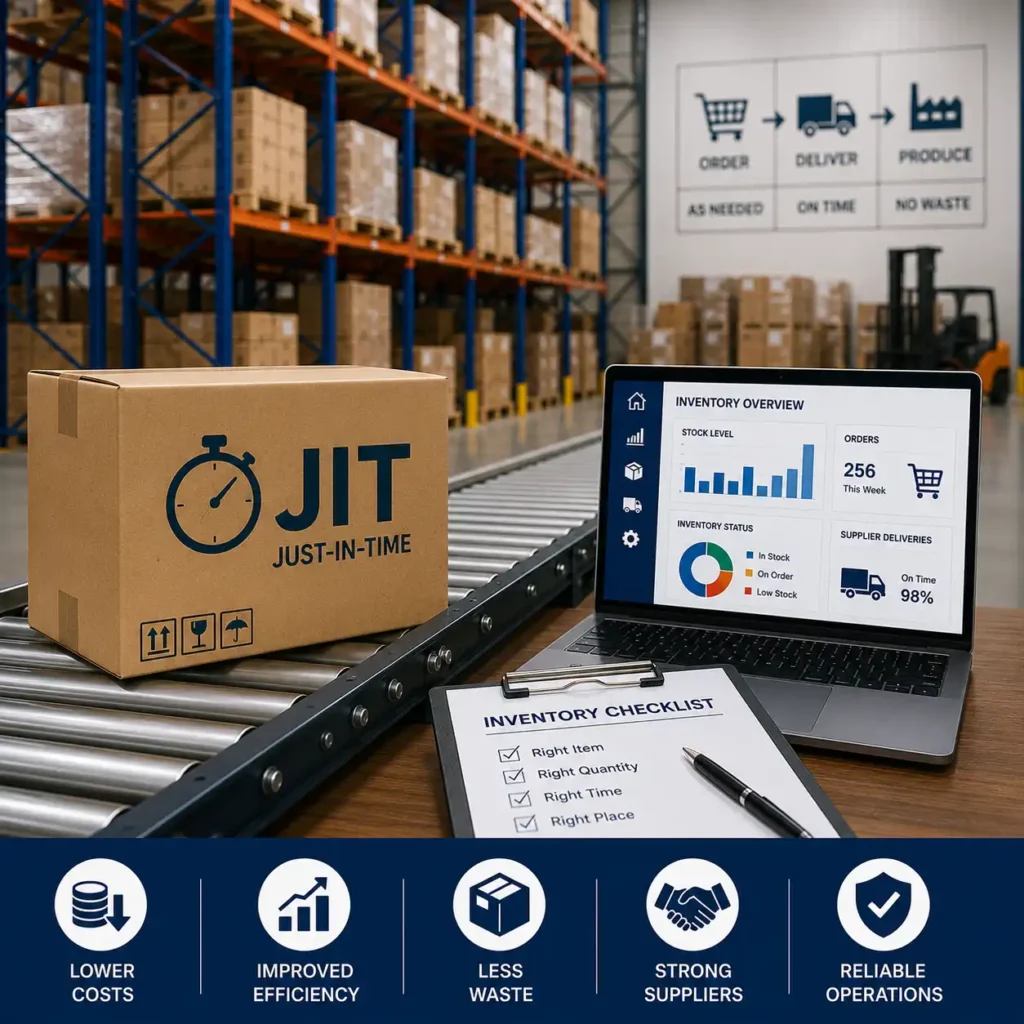
Holding too much stock ties up cash. Holding too little risks a stockout. Just-In-Time (JIT) inventory management is the strategy built to solve exactly that tension — and it’s one of the most widely used (and widely misunderstood) inventory systems in modern supply chains.
This guide covers what JIT inventory actually is, how it works, how it compares to other inventory models, real-world examples, and how to decide if it’s the right fit for your warehouse.
What Is JIT Inventory?
Just-in-time (JIT) inventory is a management method where materials, components, or finished goods are ordered and received only as they’re needed — not stockpiled in advance. The goal is simple: keep just enough stock on hand to meet current demand, nothing more.
Instead of forecasting months ahead and warehousing large volumes of product, a JIT system pulls inventory in based on real, immediate demand signals. This keeps warehousing costs low, reduces waste, and frees up capital that would otherwise sit on a shelf.
JIT originated with the Toyota Production System (TPS) in postwar Japan, where the company needed to manufacture efficiently with limited resources and space. It has since become a core part of lean manufacturing and lean warehousing practices across nearly every industry.
How JIT Inventory Works
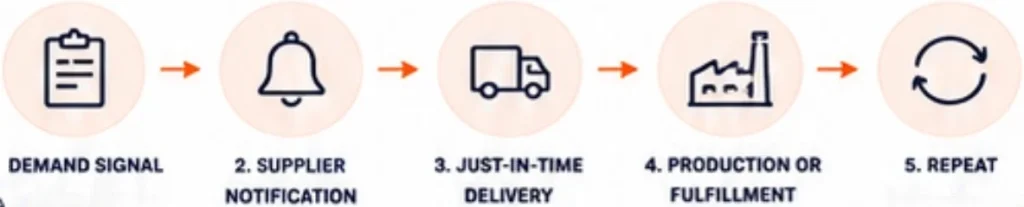
A JIT system generally follows this cycle:
- Demand signal
A customer order or production trigger initiates the process.
- Supplier notification
The business requests materials from suppliers only at that point, not in advance.
- Just-in-time delivery
Suppliers deliver the exact quantity needed, timed to arrive right before it’s required.
- Production or fulfillment
Materials move directly into production or shipping, with minimal dwell time in storage.
- Repeat
The cycle resets with the next demand signal.
This is often managed using a Kanban system — a visual signaling method (physical cards or digital boards) that tells teams when stock has dropped low enough to trigger a new order. Kanban keeps the JIT cycle running without manual guesswork.
For JIT to function, three things have to be reliable: accurate demand forecasting, strong supplier relationships, and tight coordination across the supply chain. Weakness in any one of these is where JIT systems tend to break down.
JIT vs EOQ (Economic Order Quantity)
JIT and EOQ are both inventory strategies, but they optimize for different things.
Factors
JIT Inventory
EOQ
- Goal
Minimize inventory on hand
Minimize total ordering + holding cost
- Order size
Small, frequent orders based on demand
Calculated “optimal” order quantity
- Supplier reliance
High — requires strong, responsive suppliers
Lower — orders are planned in advance
- Best for
Businesses with predictable demand and reliable suppliers
Businesses that want a mathematically balanced reorder point
i
In short: EOQ answers “how much should I order at once to minimize cost,” while JIT answers “how do I avoid ordering until I absolutely need to.”
JIT vs JIC (Just-In-Case) Inventory
This comparison became especially relevant after the supply chain disruptions of 2020–2021.
JIT (Just-In-Time)
JIC (Just-In-Case)
Lean, minimal stock, low holding costs, but vulnerable to supplier delays or demand spikes
Businesses hold buffer stock or safety stock specifically to absorb disruptions, at the cost of higher warehousing and holding expenses.
i
Many companies today run a hybrid model — JIT for predictable, fast-moving items, and JIC buffer stock for critical or hard-to-source components. This hybrid approach has become increasingly common as businesses balance lean efficiency with supply chain resilience.
Advantages of JIT Inventory
- Lower storage costs
Less inventory means less warehouse space and lower holding costs.
- Improved cash flow
Capital isn’t tied up in unsold stock.
- Reduced waste
Especially valuable for perishable goods or fast-changing product lines.
- Better quality control
Smaller, more frequent shipments are easier to inspect closely.
- Increased efficiency
Production and fulfillment processes are streamlined with less idle inventory sitting around
Disadvantages and Risks of JIT Inventory
- Supplier dependency
A single delayed shipment can stall your entire operation.
- Limited buffer stock
Sudden demand spikes can lead to stockouts and lost sales.
- Forecasting sensitivity
JIT only works if demand predictions are accurate; errors compound quickly.
- Vulnerability to disruption
Natural disasters, port delays, or geopolitical events can break a JIT chain fast, as seen industry-wide in recent years.
JIT rewards precision and punishes disruption. It works best for businesses with stable, well-understood demand patterns and dependable supplier networks — not for those operating in volatile or unpredictable markets.
Real-World JIT Inventory Examples

Toyota
The original pioneer of JIT. Parts arrive on the production line exactly when needed, minimizing warehouse storage.

Dell
Builds computers to order, sourcing components only after a customer places an order

Zara
Uses JIT-style rapid production cycles to respond to fashion trends quickly, avoiding excess seasonal stock.

McDonald's
Prepares food only after an order is placed, balancing freshness with minimal waste.

Harley-Davidson
Aligns parts inventory tightly with production schedules to reduce warehousing needs.
!
Many companies today run a hybrid model — JIT for predictable, fast-moving items, and JIC buffer stock for critical or hard-to-source components. This hybrid approach has become increasingly common as businesses balance lean efficiency with supply chain resilience.
How to Implement JIT Inventory: Step-by-Step
01
Start tracking demand data
You need reliable historical sales and seasonality data before removing safety stock.
02
Build strong supplier relationships
Negotiate clear lead times, delivery expectations, and contingency terms.
03
Introduce a Kanban or automated reorder trigger
This removes guesswork from when to reorder.
04
Reduce lot sizes gradually
Don’t cut inventory to the bone overnight — phase it in as your forecasting proves reliable.
05
Optimize your warehouse layout
JIT depends on fast put-away and retrieval — efficient racking and storage systems reduce the time between receiving and use.
06
Monitor continuously
JIT is not “set and forget” — it requires ongoing review of supplier performance and demand accuracy.
JIT Inventory Best Practices
- Diversify suppliers where possible, even within a JIT model, to reduce single-point-of-failure risk.
- Use inventory management software or a WMS to automate reorder triggers and track real-time stock levels.
- Keep a small, deliberate buffer for critical or hard-to-replace items — a "hybrid JIT" approach.
- Train warehouse staff thoroughly, since JIT relies on precise, well-executed put-away and picking processes.
- Review performance metrics regularly — supplier lead times, stockout frequency, and inventory turnover are the numbers that tell you whether JIT is actually working.
Is JIT Inventory Still Relevant Today?
Yes — despite predictions that supply chain shocks would kill off JIT in favor of just-in-case stockpiling, data shows JIT principles are still very much in use, particularly among retailers managing lean inventory-to-sales ratios. What’s changed is that most companies now build in smarter contingencies — diversified suppliers, better forecasting tools, and selective buffer stock — rather than abandoning JIT altogether.
FAQs
No. JIT means keeping the minimum inventory necessary to meet immediate demand — not eliminating inventory completely.
Automotive, retail, e-commerce, electronics, food and beverage, apparel, and even healthcare all use JIT principles in some form.
They're closely related. JIT is a specific ordering and delivery strategy; lean inventory (or lean warehousing) is the broader philosophy of eliminating waste that JIT operates within.
Supplier disruption. Because buffer stock is minimal, any delay in the supply chain can directly halt production or fulfillment.
Final Thoughts
JIT inventory isn’t a one-size-fits-all system — it’s a precision tool. Done well, it frees up cash, cuts waste, and keeps operations lean. Done without the right supplier relationships, forecasting discipline, or warehouse infrastructure, it can leave a business exposed the moment something goes wrong.
Whatever inventory strategy you run — JIT, JIC, or a hybrid — it depends on a warehouse that can receive, store, and move stock efficiently. That starts with the right racking and storage system for your space and throughput needs.
Looking to optimize your warehouse for faster put-away and retrieval? Talk to our team about racking and shelving solutions built for high-turnover inventory.