


Warehouse Inventory: How to Manage and Control It Effectively
Learn how to manage and control warehouse inventory effectively with proven strategies, best practices, tools, and techniques to optimize your warehouse operations.
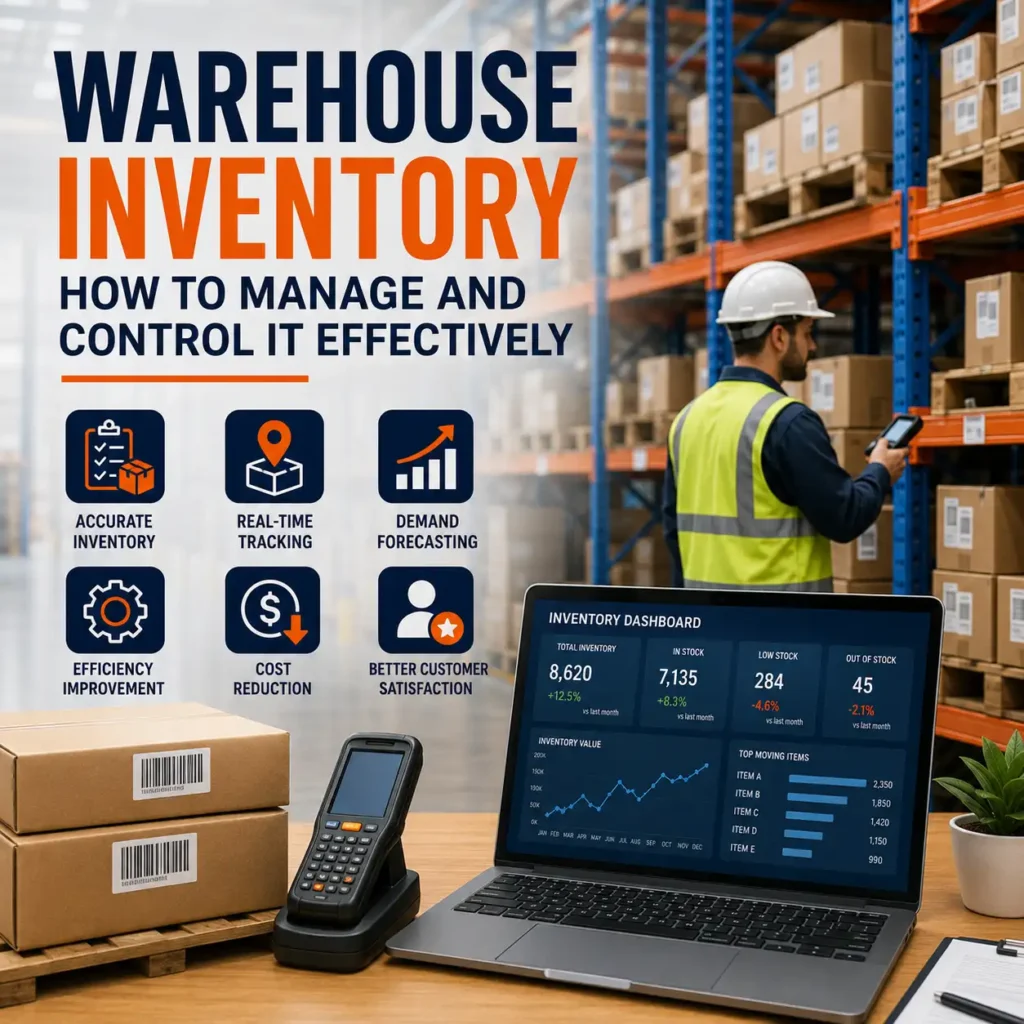
Every successful business that deals with physical goods depends on one foundational element — warehouse inventory. Whether you’re running a small distribution center or managing a large-scale fulfillment operation, how well you track, organize, and control your stock directly impacts your bottom line.
Warehouse inventory refers to all the goods, materials, and products stored in a warehouse at any given time. It sits at the heart of supply chain management, connecting procurement, production, and customer fulfillment in one continuous flow. When managed well, it keeps operations running smoothly. When neglected, it leads to costly mistakes — lost sales, excess stock, delayed shipments, and unhappy customers.
This guide is built for warehouse managers, logistics professionals, operations directors, and business owners who want real, actionable strategies to improve their inventory management. We’ll cover everything from the basics of warehouse inventory to advanced control techniques, technology tools, key performance metrics, and future trends shaping the industry.
What Is Warehouse Inventory?
Definition
Warehouse inventory is the total stock of goods stored in a warehouse facility that a company intends to sell, distribute, or use in production. It includes everything from raw materials and components to finished goods ready for shipment. At its core, warehouse inventory represents capital — and how efficiently that capital moves through your operation determines profitability.
Inventory management in a warehouse setting means knowing what you have, where it is, how much it costs to hold, and when it needs to be replenished. It’s not just about counting boxes — it’s about having the right products in the right quantities at the right time.
Types of Warehouse Inventory
Not all inventory is the same. Understanding the different types helps managers apply the right storage, handling, and tracking strategies.
Importance in Business Operations
Warehouse inventory is not a passive storage problem. It directly affects order fulfillment speed, customer satisfaction, cash flow, and operational efficiency. Businesses that treat inventory management as a strategic function rather than a back-office task consistently outperform those that don’t. According to industry data, inventory carrying costs typically account for
20 to 30 percent
of inventory value annually
making effective control one of the highest-ROI operational improvements a company can make.
Why Warehouse Inventory Management Matters

Cost Reduction
Holding inventory costs money. Warehousing space, insurance, labor, spoilage, and obsolescence all add up. Effective inventory management reduces excess stock, minimizes waste, and ensures capital isn’t tied up in slow-moving goods. By optimizing stock levels, businesses lower their carrying costs and free up working capital for growth.

Improved Efficiency
When inventory is well-organized and accurately tracked, warehouse workers spend less time searching for products, resolving discrepancies, and handling mis-picks. Streamlined processes mean faster order fulfillment, fewer errors, and higher throughput — all of which reduce operational costs and increase output without adding headcount.

Better Customer Satisfaction
Customers expect fast, accurate deliveries. Stockouts lead to backorders and cancellations. Shipping the wrong item or wrong quantity damages trust. Effective warehouse stock management ensures that orders are filled correctly and shipped on time, which builds customer loyalty and protects your brand reputation.

Reduced Stockouts and Overstocking
Both extremes — running out of stock and holding too much — are costly. Stockouts result in lost revenue and frustrated customers. Overstocking ties up cash, consumes valuable warehouse space, and risks obsolescence. Proper inventory control helps businesses walk the line between these two extremes with precision.
Common Warehouse Inventory Challenges
Even experienced operations teams face recurring challenges in managing warehouse inventory. Recognizing these obstacles is the first step toward solving them.
01
Inventory Inaccuracies
Discrepancies between physical stock and system records are one of the most widespread problems in warehouse management. They stem from data entry errors, theft, damage, or poor receiving procedures. Inaccurate inventory data leads to over-ordering, stockouts, and unreliable reporting.
02
Overstocking
Purchasing too much inventory based on inaccurate forecasts or fear of running out creates storage problems, inflates carrying costs, and increases the risk of goods becoming obsolete before they can be sold. Seasonal products and short-shelf-life goods are especially vulnerable.
03
Understocking
The opposite problem — not having enough product on hand — causes missed sales opportunities, disappointed customers, and rushed (expensive) restocking. Understocking often results from poor demand forecasting or inconsistent reorder processes.
04
Human Errors
Manual data entry, handwritten labels, and paper-based picking processes are prone to mistakes. A single miskeyed number can throw off your entire inventory count. Human error is one of the most common and most preventable causes of inventory problems.
05
Lack of Visibility
When warehouse teams can’t see real-time stock levels across locations, they make decisions based on outdated or incomplete information. Lack of inventory visibility is particularly damaging for businesses operating multiple warehouses or distribution centers.
06
Poor Warehouse Organization
Disorganized storage layouts slow down pick-and-pack operations, increase error rates, and make cycle counting difficult. If workers can’t find products quickly, productivity suffers across the board
How to Manage Warehouse Inventory Effectively
01
Inventory Inaccuracies
Effective inventory management starts with a solid plan. Inventory planning involves determining how much stock to hold at any given time, when to reorder, and how to allocate space efficiently. It requires input from sales forecasts, historical data, supplier lead times, and warehouse capacity.
A well-structured inventory plan reduces the likelihood of stockouts and excess, and gives procurement teams a reliable framework for purchasing decisions.
02
Demand Forecasting
Demand forecasting uses historical sales data, market trends, seasonal patterns, and sometimes machine learning algorithms to predict future product demand. Accurate forecasting is the foundation of smart inventory planning. Businesses that invest in forecasting tools reduce both overstock and stockout situations significantly.
For example, a sporting goods retailer might analyze three years of sales data to predict demand for summer equipment, allowing them to pre-position inventory at the right warehouses before the season begins.
03
Inventory Classification Methods — ABC Analysis
Not all inventory deserves equal attention. ABC analysis categorizes products based on their value and impact on the business:
A-items: High-value products that represent roughly 70 to 80 percent of total inventory value but only 10 to 20 percent of total items. These require close monitoring, frequent counts, and tight control.
B-items: Mid-range products that represent moderate value and volume. These require regular review but less intensive oversight.
C-items: Low-value, high-volume items. They represent a large number of SKUs but contribute little to overall revenue. These need less attention but still must be tracked to prevent stockouts.
ABC analysis helps managers prioritize where to focus their time and resources for maximum impact.
04
Inventory Tracking Systems
Manual tracking methods — spreadsheets, paper logs, clipboards — were once the standard. Today, they’re a liability. Modern inventory tracking systems use barcodes, RFID tags, and digital platforms to log every product movement in real time. This gives warehouse managers an accurate, up-to-the-minute picture of their stock.
Perpetual inventory systems update records continuously as items are received, moved, or shipped. This is far more accurate than periodic inventory, which only counts stock at scheduled intervals.
05
Warehouse Layout Optimization
The physical arrangement of your warehouse has a direct impact on inventory accuracy and efficiency. Best practices for layout optimization include:
Positioning fast-moving (A-items) closest to picking and shipping zones to reduce travel time. Grouping related SKUs together to simplify order picking. Creating clear, labeled aisles and storage locations. Using vertical space efficiently with appropriate racking systems. Designating separate areas for receiving, storage, picking, packing, and shipping.
A well-designed warehouse layout reduces the time workers spend walking, minimizes errors, and supports faster order fulfillment.
06
Regular Inventory Audits
Inventory audits involve physically counting and verifying stock against system records. Full physical inventories — typically conducted annually or semi-annually — shut down operations temporarily but provide a complete accuracy check. While necessary, they’re disruptive and resource-intensive.
07
Cycle Counting
Cycle counting is a smarter alternative to full physical inventories. Instead of counting everything at once, warehouse teams count a rotating subset of inventory on a continuous basis — daily, weekly, or monthly. High-value A-items might be counted weekly, while C-items are counted quarterly.
Cycle counting maintains ongoing inventory accuracy, catches errors early, and doesn’t require shutting down operations. It’s one of the most effective and widely adopted inventory counting procedures in modern warehouses.
Best Practices for Warehouse Inventory Control
01
Use Inventory Management Software
Purpose-built inventory software eliminates the limitations of spreadsheets and manual systems. Good inventory software provides real-time stock visibility, automated reorder alerts, integration with order management and ERP systems, and detailed reporting. Cloud-based solutions allow managers to access data from anywhere, which is invaluable for multi-site operations.
02
Implement Barcode and RFID Technology
Barcode scanning has been a warehouse staple for decades, and for good reason — it’s accurate, fast, and affordable. Each product gets a unique barcode that workers scan during receiving, putaway, picking, and shipping. This creates a clean digital trail for every unit.
RFID (Radio Frequency Identification) takes this further. RFID tags can be read in bulk without line-of-sight scanning, making them ideal for high-volume operations. While the upfront cost is higher, RFID significantly reduces counting time and error rates.
03
Set Reorder Points
A reorder point (ROP) is the stock level at which a new purchase order should be triggered. It’s calculated based on lead time demand and safety stock. When inventory drops to the reorder point, the system automatically flags a replenishment need — preventing stockouts without requiring manual monitoring.
Formula: Reorder Point = (Average Daily Sales x Lead Time) + Safety Stock
04
Monitor Inventory KPIs
You can’t improve what you don’t measure. Tracking inventory performance metrics on a consistent basis gives managers the data they need to identify problems and optimize operations. Key KPIs are covered in detail in a later section of this article.
05
Train Warehouse Staff
Technology is only as effective as the people using it. Ongoing staff training ensures that everyone follows standardized procedures for receiving, labeling, putaway, picking, and counting. Well-trained teams make fewer errors, adapt to system updates quickly, and take greater ownership of inventory accuracy.
06
Standardize Inventory Procedures
Documented, standardized operating procedures (SOPs) remove ambiguity and ensure consistency across shifts and team members. When everyone follows the same process for goods receiving, putaway, cycle counting, and returns, inventory accuracy improves and problems are easier to diagnose.
Warehouse Inventory Control Techniques
■
FIFO — First In, First Out
FIFO means the oldest inventory is sold or used first. This is the standard approach for perishable goods, food products, pharmaceuticals, and anything with an expiration date. It minimizes waste and ensures product freshness. Even for non-perishable goods, FIFO is often preferred because it keeps stock from sitting unused and becoming obsolete.
■
LIFO — Last In, First Out
LIFO means the most recently received inventory is used or sold first. This approach is more common in industries where older stock is less relevant — like certain raw materials or commodities. In the United States, LIFO is also used for tax accounting purposes because it can reduce taxable income when costs are rising. However, it’s banned under International Financial Reporting Standards (IFRS).
■
JIT — Just-In-Time
Just-In-Time inventory management involves ordering and receiving goods only as they’re needed for production or sale — minimizing the amount of inventory held at any time. Pioneered by Toyota, JIT reduces carrying costs dramatically. The tradeoff is a reliance on highly reliable suppliers and logistics. Any supply chain disruption can halt production when you’re running lean.
■
Economic Order Quantity (EOQ)
EOQ is a formula-based approach to determining the optimal order quantity that minimizes total inventory costs — balancing ordering costs against holding costs.
Formula: EOQ = Square root of (2 x Demand x Order Cost / Holding Cost per Unit)
EOQ helps businesses avoid both over-ordering and under-ordering by finding the mathematical sweet spot for each SKU.
■
Safety Stock Management
Safety stock is a buffer of extra inventory held to guard against demand uncertainty and supply delays. The right amount of safety stock depends on demand variability, lead time variability, and the acceptable risk of a stockout. Too little safety stock leaves you vulnerable; too much inflates carrying costs. Modern inventory software can calculate optimal safety stock levels dynamically based on real-time data.
Role of Technology in Warehouse Inventory Management
01
Warehouse Management Systems (WMS)
A Warehouse Management System is the backbone of modern warehouse operations. A WMS manages every aspect of warehouse activity — from receiving and putaway to picking, packing, shipping, and inventory reporting. It integrates with ERP systems, e-commerce platforms, and transportation management systems to create a unified operational view.
Leading WMS platforms include SAP Extended Warehouse Management, Manhattan Associates, Oracle WMS, and cloud-native options like Fishbowl, Cin7, and Extensiv. Choosing the right WMS depends on warehouse size, order volume, SKU complexity, and integration requirements.
02
Automation and Robotics
Warehouse automation has accelerated dramatically in recent years. Automated Storage and Retrieval Systems (AS/RS) use robotic cranes and conveyors to store and retrieve goods without human intervention. Autonomous Mobile Robots (AMRs) navigate warehouse floors to transport goods, freeing workers from repetitive travel tasks.
Automation reduces labor costs, increases picking speed and accuracy, and enables 24/7 operations without fatigue-related errors. Companies like Amazon, Walmart, and DHL have invested heavily in warehouse robotics — and the technology is becoming increasingly accessible to mid-sized operations.
03
AI-Powered Forecasting
Artificial intelligence is transforming demand forecasting. AI systems analyze historical sales data, market trends, weather patterns, economic indicators, and even social media activity to predict demand with greater accuracy than traditional statistical models. This improves inventory planning, reduces excess stock, and cuts stockout frequency.
04
Real-Time Inventory Tracking
Real-time inventory management means every movement of every item is captured and reflected in the system instantly. Whether a pallet is received at the dock, moved to a storage location, or picked for an order — the system knows immediately. This eliminates the guesswork that leads to costly errors and gives managers total stock visibility at all times.
05
Cloud-Based Inventory Solutions
Cloud-based inventory platforms offer accessibility, scalability, and integration capabilities that legacy on-premise systems can’t match. Teams can access inventory data from any device, from any location, at any time. Updates happen automatically, and integration with e-commerce platforms, shipping carriers, and accounting software is typically seamless.
Key Warehouse Inventory Metrics to Track
Inventory Turnover Ratio
This measures how many times inventory is sold and replaced over a given period. A higher turnover ratio generally indicates efficient inventory management and strong sales. Low turnover signals overstocking or slow-moving products.
Formula: Inventory Turnover = Cost of Goods Sold / Average Inventory Value
Carrying Cost of Inventory
Carrying cost represents the total cost of holding inventory, expressed as a percentage of inventory value. It includes warehousing costs, insurance, taxes, obsolescence, and opportunity cost. Most businesses target a carrying cost between 20 and 30 percent. Reducing this number directly improves profitability.
Order Accuracy Rate
Order accuracy measures the percentage of orders shipped correctly — right product, right quantity, right destination. High order accuracy is critical for customer satisfaction and reduces the cost of returns and re-shipments.
Formula: Order Accuracy = (Correct Orders / Total Orders) x 100
Stockout Rate
The stockout rate tracks how often products are unavailable when customers order them. High stockout rates lead to lost revenue and damaged relationships. Tracking this KPI helps identify which SKUs need tighter reorder management.
Inventory Accuracy
Inventory accuracy compares what the system says you have versus what you physically have in the warehouse. World-class warehouses achieve accuracy rates of 99 percent or higher. Most warehouses average around 65 to 75 percent without active cycle counting programs.
Formula: Inventory Accuracy = (Counted Items Matching Records / Total Items Counted) x 100
Fill Rate
Fill rate measures the percentage of customer orders fulfilled from available stock without backorders or delays. A high fill rate indicates strong alignment between inventory levels and customer demand.
Benefits of Effective Warehouse Inventory Management
01
Increased Productivity
When inventory is accurately tracked and well-organized, workers spend less time on non-value-added activities like searching for products or correcting errors. Throughput increases without proportional increases in labor costs.
02
Reduced Operational Costs
Better inventory control means less money spent on rush orders, emergency restocking, excess storage, spoilage, and returns processing. Every dollar saved on inventory costs drops directly to the bottom line.
03
Improved Inventory Visibility
Real-time inventory data gives decision-makers across the organization — from purchasing to sales to finance — a single source of truth. Better visibility leads to better decisions at every level.
04
Better Decision-Making
Accurate, timely inventory data supports smarter purchasing, pricing, and promotional decisions. When you know exactly what you have and how it’s moving, every business decision becomes more informed.
05
Higher Profitability
All of the above benefits combine to produce a measurable impact on profitability. Companies that excel at inventory management consistently outperform competitors on key financial metrics.
Future Trends in Warehouse Inventory Management
AI and Machine Learning
The adoption of AI in warehouse operations will continue to accelerate. Beyond demand forecasting, AI is being applied to dynamic slotting (optimizing where products are stored based on demand patterns), predictive maintenance, and automated replenishment decisions. Machine learning models improve over time, meaning the longer they run, the more accurate and valuable they become.
Predictive Analytics
Predictive analytics goes beyond describing what happened to anticipating what will happen. By analyzing patterns in historical data, predictive tools can flag potential stockouts weeks in advance, identify suppliers likely to cause delays, or detect emerging demand trends before they show up in sales reports.
IoT-Enabled Warehouses
The Internet of Things (IoT) is connecting physical warehouse assets — shelves, forklifts, pallets, temperature sensors — to digital networks. Smart shelves can detect when products are removed and automatically trigger replenishment. Temperature and humidity sensors protect sensitive inventory. Connected forklifts generate data on utilization, routes, and maintenance needs. The result is a warehouse that actively monitors itself.
Smart Inventory Systems
Smart inventory systems combine WMS, AI, IoT, and real-time tracking into a unified intelligent platform. These systems can autonomously adjust reorder points, redirect stock between locations, and optimize pick paths without human input — handling the routine complexity of inventory management so teams can focus on higher-value tasks.
Automation Technologies
As automation costs continue to fall, more warehouses will adopt robotic picking systems, autonomous guided vehicles (AGVs), drone inventory counting, and automated conveyor networks. The warehouses of the next decade will look dramatically different from those of today — faster, more accurate, and less labor-intensive.
Frequently Asked Questions (FAQs)
Warehouse inventory management is the process of overseeing and controlling the storage, movement, and tracking of goods within a warehouse. It encompasses everything from receiving stock and organizing it in storage to picking orders, conducting audits, and replenishing stock. The goal is to maintain accurate stock levels, minimize costs, and ensure products are available when needed.
Inventory management is the broader discipline — it covers planning, purchasing, storing, and tracking inventory across the supply chain. Inventory control is a subset of management focused specifically on maintaining accurate stock records, preventing shrinkage, and ensuring physical counts match system data. Think of control as the operational execution and management as the strategic framework.
The most effective methods include cycle counting for continuous accuracy, ABC analysis for prioritizing high-value items, FIFO for perishable goods, barcode or RFID scanning for real-time tracking, and setting automated reorder points within a warehouse management system. The best approach combines multiple methods tailored to your specific product mix and operational scale.
It depends on the method. Full physical inventories are typically done once or twice per year. With cycle counting, portions of inventory are counted on a rotating schedule — daily, weekly, or monthly. A-items (high-value products) should be counted more frequently, perhaps monthly or even weekly. The goal is to maintain high inventory accuracy without the disruption of shutting down operations for a full count.
A WMS is software designed to manage all warehouse operations — receiving, putaway, picking, packing, shipping, and inventory tracking. If your warehouse processes more than a few hundred orders per day, manages a diverse SKU range, or operates multiple locations, a WMS is likely a worthwhile investment. It replaces manual processes, reduces errors, and provides real-time visibility that spreadsheets simply cannot offer.
Common causes include manual data entry errors, poor receiving procedures, theft or damage that goes unrecorded, mislabeled products, inadequate staff training, and infrequent cycle counts. The most effective way to address inventory inaccuracies is to implement barcode or RFID scanning, standardize receiving procedures, and maintain a regular cycle counting program.
Safety stock is extra inventory held as a buffer against unexpected demand increases or supplier delays. A simple formula for safety stock is: Safety Stock = (Maximum Daily Sales x Maximum Lead Time) minus (Average Daily Sales x Average Lead Time). More sophisticated calculations factor in demand variability and service level targets. Most modern inventory software can calculate and dynamically adjust safety stock levels automatically.
FIFO (First In, First Out) means the oldest inventory is used or sold first — essential for perishable goods and products with expiration dates. LIFO (Last In, First Out) means the most recently received inventory is used first. LIFO is rare in physical warehouse operations but is used in certain accounting contexts in the US to reduce taxable income during periods of rising costs. For most warehouse operations, FIFO is the preferred and more practical method.
To reduce carrying costs: implement demand forecasting to avoid overstocking, set accurate reorder points, conduct regular cycle counts to identify slow-moving stock, negotiate shorter lead times with suppliers to reduce safety stock needs, and use ABC analysis to focus holding reductions on low-value, high-volume items. Regularly reviewing and acting on inventory turnover data is also essential.
The most important KPIs for warehouse inventory management include Inventory Turnover Ratio, Inventory Accuracy Rate, Order Accuracy Rate, Stockout Rate, Fill Rate, Carrying Cost as a Percentage of Inventory Value, and Days of Inventory on Hand. Tracking these metrics consistently — and setting clear targets for each — enables data-driven decisions that improve performance over time.
Conclusion
Warehouse inventory is far more than a list of products on shelves. It is the operational heartbeat of any product-based business — and how well you manage and control it determines your efficiency, your costs, and ultimately your ability to satisfy customers and grow profitably.
The most successful warehouse operations share a common approach: they combine solid planning with the right technology, standardized processes, trained teams, and data-driven decision-making. They use tools like cycle counting, ABC analysis, WMS platforms, and real-time tracking to stay ahead of problems rather than reacting to them. They monitor KPIs consistently and use those metrics to drive continuous improvement.
The landscape is also evolving fast. AI-powered forecasting, IoT-connected warehouses, autonomous robots, and cloud-based inventory platforms are no longer reserved for enterprise giants. These technologies are increasingly accessible to mid-sized operations — and businesses that adopt them now will hold a significant competitive advantage.
If your current inventory management approach relies heavily on manual processes, outdated spreadsheets, or infrequent physical counts, now is the time to make a change. Start with an honest audit of your current accuracy rates and carrying costs. Identify your biggest pain points. Then build a roadmap — whether that’s implementing cycle counting, deploying a WMS, or integrating RFID technology — and execute it systematically.