
Warehouse Storage Techniques: Complete Guide to Space Efficiency
Explore the most effective warehouse storage techniques to maximize space, improve efficiency, and streamline operations in your logistics facility.
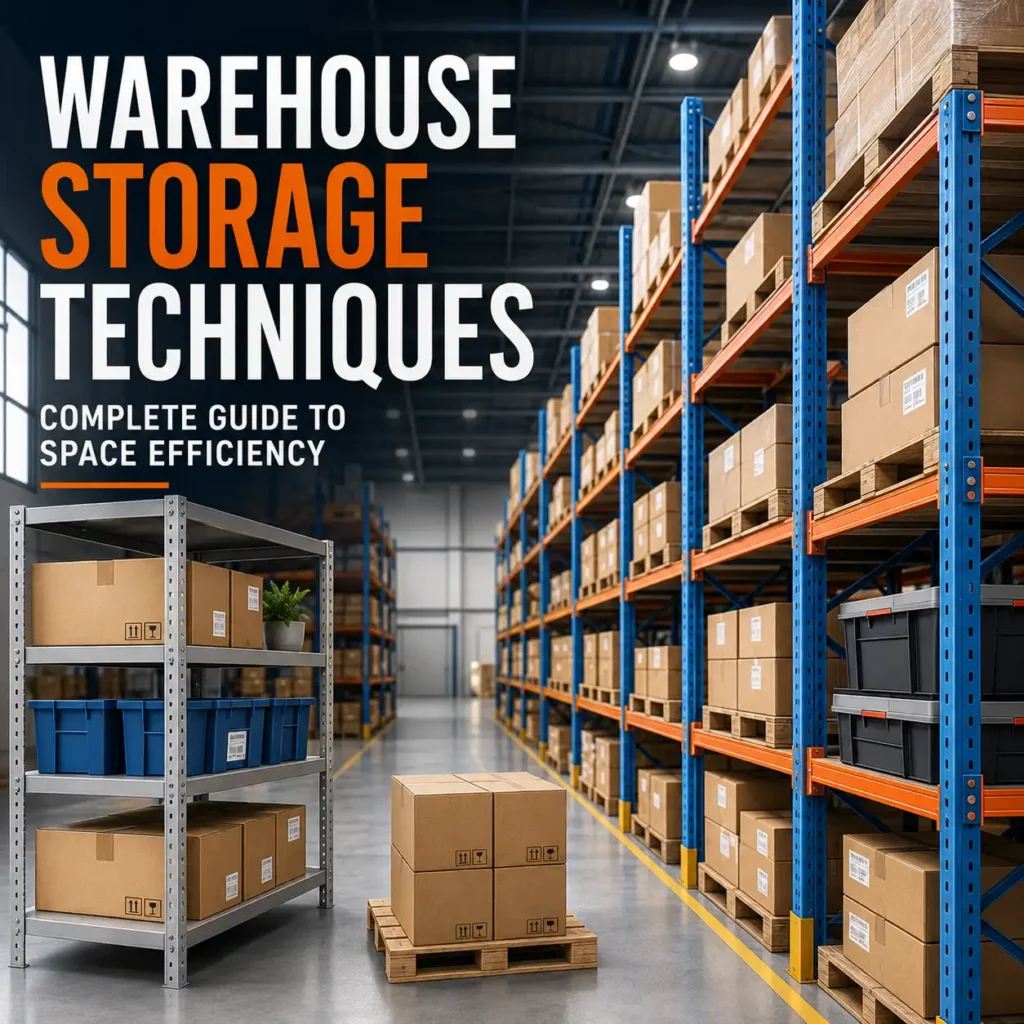
Walk into any high-performing warehouse and one thing becomes immediately clear — organization is not accidental. Every rack, every aisle, every storage location has been deliberately chosen to support speed, accuracy, and efficiency. Behind that organization lies a set of deliberate decisions about warehouse storage techniques: the methods used to house, organize, and retrieve goods within a logistics facility.
Choosing the right warehouse storage technique is one of the most consequential decisions a logistics manager can make. It directly affects how quickly orders are fulfilled, how safely staff can work, how much inventory can be held within a given footprint, and ultimately how competitive the operation is. Get it right and you unlock capacity, speed, and cost savings. Get it wrong and you pay for it every day in wasted space, slow picking, and avoidable errors.
What Are Warehouse Storage Techniques?
Warehouse storage techniques are the methods and systems used to organize, house, and manage goods within a logistics facility. They determine where products are placed, how they are accessed, how space is utilized, and how efficiently goods can be stored and retrieved during day-to-day operations.
Storage techniques range from basic floor stacking to sophisticated automated racking systems. The right technique — or combination of techniques — depends on a range of variables specific to each warehouse: the type and quantity of goods handled, the available floor space and ceiling height, packaging formats, order profiles, and throughput requirements.
Why Choosing the Right Storage Technique Matters
The storage system you choose shapes every aspect of your warehouse operations. It determines how far workers travel to pick orders, how many SKUs you can accommodate, how safely staff and goods coexist in the facility, and how quickly you can respond to surges in demand. A poorly chosen storage system creates friction at every step — slowing throughput, increasing errors, and driving up labor costs. A well-chosen system does the opposite: it accelerates operations, reduces costs, and creates the physical foundation for a highly efficient warehouse.
Before selecting a storage technique, every logistics operation should analyze four core variables — the characteristics of the goods being stored, the space available in the facility, the packaging formats in use, and the inbound and outbound workflows. With this data in hand, choosing the right solution becomes a structured decision rather than a guess.
Floor Storage: The Basics of Block Stacking

What Is Floor Storage?
Floor storage, also known as block stacking, is the most fundamental warehouse storage technique. Goods — typically on pallets — are placed directly on the floor and stacked vertically in blocks. No racking structures are required. High-turnover items stored on the floor are usually grouped into a dedicated zone within the warehouse to make location and retrieval more straightforward during order picking and inventory replenishment.
Advantages of Floor Storage
The primary advantage of floor storage is cost. It is the least expensive storage approach because it requires no racking investment. For businesses with very limited budgets, temporary storage needs, or products that cannot be racked — oversized loads, unusually shaped goods, or items awaiting processing — block stacking offers a practical short-term solution.
Floor storage also offers flexibility. Without fixed racking structures, the layout can be reconfigured quickly to accommodate changes in product mix or volume.
Disadvantages of Floor Storage
- Despite its low cost, floor storage comes with serious operational drawbacks that make it unsuitable as a long-term primary storage strategy for most warehouses.
- Space inefficiency is the biggest problem. Block stacking can only go so many units high before stability becomes a safety concern, which means the upper portion of the warehouse — often the most abundant available space — goes completely unused. A warehouse with a 10-meter ceiling achieves very little of its potential storage capacity with floor storage alone.
- Accessibility is another major limitation. Locating a specific SKU in a block-stacked area requires workers to navigate around stacks, often moving other pallets to reach the one they need. This dramatically increases pick times and the risk of product damage.
- The risk of collapse is also significant. Improperly stacked pallets can topple, creating serious safety hazards for workers and causing product damage. For these reasons, floor storage is typically reserved for specific use cases rather than used as the primary storage strategy in a well-designed warehouse.
Pallet Rack Storage: The Backbone of Modern Warehousing
Pallet racking is the most widely used warehouse storage technique worldwide. Racking structures optimize vertical space in the facility, increase accessibility to stored goods, improve safety for both workers and products, and support higher warehouse throughput compared to floor storage.
Pallet rack storage can be divided into two broad categories: systems that provide direct access to every pallet, and high-density compact systems that maximize storage capacity at the cost of some accessibility. Understanding the distinction between these two approaches is central to making the right storage decision for your operation.
Pallet Rack Storage with Direct Access
Direct access pallet racking systems allow operators to reach any stored pallet directly from the working aisles, without moving other loads first. Every pallet position is independently accessible. This makes direct access systems ideal for operations with a large number of SKUs, varied order profiles, and a need for flexible, fast retrieval.
Standard Pallet Racking
Standard pallet racking — sometimes called selective pallet racking — is the most common storage system found in warehouses globally. Its popularity stems from its versatility, relatively low cost, and ease of implementation. Pallet racks can be configured as single-deep (one pallet per slot, accessible directly from the aisle) or double-deep (two pallets per slot, with the rear pallet accessed by a reach truck after removing the front pallet).
Single-deep racking provides the highest level of accessibility and is compatible with virtually any type of forklift or handling equipment, as long as the aisle width is sufficient. Double-deep racking reduces the number of aisles needed, increasing storage density, but it requires a reach truck capable of handling the extended depth and means the rear pallet is not directly accessible until the front one is removed.
Standard pallet racking is the default starting point for most warehouse storage planning. It scales easily, integrates with warehouse management systems, and can accommodate a wide range of pallet sizes, weights, and product types.
Mobile Pallet Racking Systems
Mobile pallet racking takes standard racking a step further by mounting the rack structures on motorized bases that move laterally along embedded floor rails. When an operator needs to access a particular aisle, they use a radio control to command the adjacent rack units to move, opening the required aisle while closing others.
This system eliminates the need for permanent aisles between every rack row. Instead of dedicating floor space to multiple fixed aisles, mobile racking needs only one working aisle at a time — dramatically increasing the number of pallet positions that can fit within the same floor area. The result is storage density significantly higher than standard fixed racking, while maintaining direct access to every individual pallet position.
Mobile pallet racking is particularly well-suited to cold storage facilities, where every square meter of temperature-controlled space is expensive to build and operate, and where maximizing storage density per square meter delivers significant economic value.
Very narrow aisle racking systems use specialized handling equipment — typically turret trucks or man-up order pickers — that can operate in aisles far narrower than standard forklifts require. By reducing aisle width, VNA systems increase the proportion of floor space dedicated to storage versus access. At the same time, VNA equipment can reach greater heights than standard forklifts, further maximizing vertical storage capacity.
VNA racking provides direct access to every pallet while delivering storage density closer to compact systems. It is a strong choice for operations that need high SKU variety and individual pallet accessibility but want to maximize the number of pallet positions within a constrained footprint.
High-Density Pallet Racking Storage
Compact storage is best suited to operations that handle a limited number of SKUs in high quantities — where storage density matters more than the ability to retrieve any individual pallet on demand.
■ Drive-In Pallet Racking
- Drive-in pallet racking eliminates the aisles between rack rows entirely. Instead, operators drive their forklifts directly into the rack structure along internal lanes, depositing pallets onto rails at the lane’s depth. Each lane can hold multiple pallets of the same SKU, stored one behind the other.
- Because the forklift enters and exits from the same end of the lane, drive-in racking naturally follows a LIFO (Last In, First Out) sequence — the most recently stored pallet is the first one retrieved. This makes it suitable for non-perishable goods where stock rotation sequence is less critical.
- Drive-in racking delivers very high storage density and is cost-effective to install. Its limitation is accessibility — to retrieve a pallet from deep within a lane, the pallets in front of it must be removed first. For this reason, it works best when full lanes of the same product are stored and retrieved together.
■ Push-Back Pallet Racking
- Push-back racking systems use slightly inclined levels fitted with free-rolling carts or carriages. When a new pallet is loaded onto the rack, it pushes the previously stored pallets back along the inclined rails. When a pallet is removed from the front, gravity gently moves the pallets stored behind it forward to the retrieval position.
- Push-back racking operates on a LIFO basis and can accommodate multiple pallets deep per lane — typically two to five deep depending on configuration. It offers higher storage density than single-deep selective racking while maintaining a single working aisle per rack row. Loading and unloading both happen from the same aisle face, simplifying forklift operations compared to drive-in systems where the operator must enter the structure.
- Push-back racking is a practical middle ground for operations that need higher density than selective racking can provide but want simpler operation than drive-in systems require.
■ Live Pallet Racking (Pallet Flow Racking)
- Live pallet racking — also called pallet flow racking — uses slightly sloped lanes fitted with roller conveyors. Pallets are loaded at the higher end of the lane and gravity carries them forward to the lower retrieval end. As each pallet is removed from the front, the ones behind it roll forward automatically to fill the position.
- This system naturally enforces a FIFO (First In, First Out) inventory rotation — the first pallet to enter the lane is always the first to be retrieved. This makes live pallet racking the preferred high-density storage solution for perishable goods, products with expiration dates, pharmaceuticals, food and beverage, and any inventory where stock rotation sequence is critical.
- Live pallet racking requires separate loading and retrieval aisles — one at each end of the rack — which means it needs more total floor space than drive-in systems. However, it delivers excellent throughput because loading and retrieval operations can happen simultaneously without interfering with each other.
■ Pallet Shuttle System
- The Pallet Shuttle is an advanced high-density storage solution that incorporates a motorized shuttle vehicle operating within the storage channels. Rather than requiring a forklift to enter the rack structure — as with drive-in systems — the Pallet Shuttle vehicle travels autonomously within the lane, carrying pallets to and from their storage positions.
- The operator places a pallet at the entry point of the channel, and the shuttle carries it to the next available position deep within the lane. On retrieval, the process reverses — the shuttle brings the pallet to the aisle face, where the forklift collects it. This separation of forklift operation and internal pallet movement makes the Pallet Shuttle significantly faster than drive-in racking and reduces wear on both the racking structure and the handling equipment.
- The Pallet Shuttle is available in both manually operated versions — where a single shuttle is moved between lanes by the forklift operator — and fully automated versions that integrate with stacker cranes for complete autonomous operation. The automated Pallet Shuttle is one of the most efficient high-density storage solutions available for operations with consistent, high-volume stock profiles.
Storage Techniques for Special and Bulky Products
Not all warehouse goods fit neatly onto standard pallets or within conventional racking structures. Long, heavy, or irregularly shaped products require specialized storage solutions designed around their unique characteristics.

Cantilever Racking
- Cantilever racking is the standard solution for storing long, bulky products such as pipes, steel profiles, timber, aluminum extrusions, and other goods that cannot be palletized in the conventional sense. Instead of shelves or rails, cantilever racks use load-bearing arms extending horizontally from vertical columns. Products are placed across the arms, which can be adjusted in height and length to accommodate different load dimensions.
- Cantilever racking provides direct access to every stored item from the working aisle, making it straightforward to locate and retrieve specific products without moving other loads. It is compatible with standard forklifts and specialized long-load handling equipment. The open structure of cantilever racking also makes it easy to visually inspect stock and quickly identify inventory levels.

Racking for Reels and Drums
- Reels, cables, wires, drums, and cylindrical loads present their own storage challenges — they are heavy, awkward to handle, and prone to rolling if not properly secured. Specialized racking accessories designed for these load types mount onto standard pallet racking frames, adapting the structure to safely support and facilitate the handling of cylindrical goods.
- These accessories can be customized to match the specific dimensions, weight, and handling requirements of the products, making them a flexible solution for manufacturers and distributors who work with reels, cables, hoses, or similar products.
Optimal Location Management: Getting the Most From Your Storage System
Selecting the right racking system is only half the challenge. How you assign products to storage locations within that system has an equally significant impact on operational efficiency. Poor location management — placing products without a logical system — leads to long travel times, slow picking, and frustrated workers. Smart location management reduces travel, speeds throughput, and makes the warehouse easier to operate.

Slotting Strategies
- Effective slotting means placing the right products in the right locations based on how frequently they are accessed and how they relate to other products in the picking workflow.
- Fast-moving A-items should be located closest to picking and dispatch areas, minimizing the distance workers travel for the products they handle most. Slow-moving C-items can be stored in less accessible locations further from the primary workflows. Related items that are frequently picked together should be grouped in adjacent locations to reduce travel between picks. Heavy items should be stored at an ergonomically appropriate height — never requiring workers to lift heavy loads from floor level or above shoulder height.

Warehouse Management Systems and Automatic Location Assignment
- Manual slotting decisions are time-consuming and quickly become outdated as product mix and demand patterns change. A warehouse management system (WMS) automates location assignment by analyzing variables such as product type, SKU, turnover rate, size, weight, and picking frequency. The WMS continuously monitors inventory movements and can recommend or automatically execute slotting adjustments to maintain optimal location assignments as conditions change.
- For operations with hundreds or thousands of SKUs, WMS-driven location management is not just a productivity tool — it is a competitive necessity. The difference between optimal and poor slotting in a large warehouse can represent hours of labor time per day and significant differences in order fulfillment speed.
Automated Storage and Retrieval Systems as a Storage Technique
Automated storage and retrieval systems (AS/RS) represent the most advanced warehouse storage technique available today. Rather than relying on human operators to navigate aisles and manually handle goods, AS/RS solutions use automated handling equipment — stacker cranes, conveyor networks, and shuttle vehicles — to store and retrieve goods with complete autonomy.
Automation delivers capabilities that manual systems fundamentally cannot match. Stacker cranes operate in very narrow aisles and reach heights far beyond what any forklift can safely access, maximizing storage density. They operate continuously without fatigue, handling inflows and outflows of goods 24 hours a day. Every movement is logged in real time by the integrated WMS, maintaining inventory accuracy at levels that manual operations struggle to achieve.
The speed advantage of automation is particularly significant for high-volume operations. Where a human operator might complete a limited number of storage or retrieval cycles per hour, an automated stacker crane can execute many more — consistently, around the clock, without variation in performance.
One of the most valuable operational benefits of automated storage is error elimination. In manual warehouses, misplaced pallets, missed scans, and incorrect putaway are common and costly. In an automated system, the WMS assigns every location and directs every movement — there is no human variability in the process. The result is significantly higher inventory accuracy, fewer mis-picks, and lower costs associated with error correction, returns, and re-shipments.
When to Consider Automation
Automation is not the right solution for every warehouse. It delivers the greatest value in operations with high, consistent throughput volumes, limited floor space, a need for round-the-clock availability, and products well-suited to automated handling. For operations with lower volumes, highly variable product mixes, or facilities that do not support the structural requirements of automated racking, manual or semi-automated solutions may deliver a better return on investment.
The decision to automate should be based on a thorough analysis of current and projected throughput, available facility dimensions, SKU profile, and total cost of ownership over a multi-year horizon.
How to Choose the Right Warehouse Storage Technique
With so many storage options available, the selection process can feel overwhelming. In practice, it comes down to a structured analysis of four key variables.
Key Warehouse Storage Metrics to Track
Monitoring performance metrics helps you evaluate whether your current storage technique is delivering the efficiency your operation needs — and identifies where improvements are possible.
Storage Utilization Rate: The percentage of available storage locations currently occupied. Aim for 80 to 85 percent utilization — higher rates begin to create operational bottlenecks. Order Pick Rate: The number of order lines picked per hour per worker. A strong indicator of how well your storage layout and slotting strategy support picking efficiency. Inventory Accuracy: The percentage of system records that match physical stock counts. Poor accuracy often signals slotting or receiving process problems. Space Efficiency: The ratio of usable storage capacity to total warehouse floor area. Comparing this before and after a storage system change reveals the real impact of your decision. Put-Away Time: The average time to store incoming goods from the receiving dock. High put-away times indicate inefficient storage assignments or poor receiving-to-storage workflows. Travel Time Per Pick: The average distance or time workers travel per pick. Reducing travel time is one of the highest-impact ways to improve warehouse labor productivity.
Best Practices for Warehouse Storage Organization
Apply ABC Analysis to Slotting
Use ABC analysis to classify inventory by movement frequency and value, then assign storage locations accordingly. A-items — fast-moving, high-value products — should occupy the most accessible, centrally located storage positions. C-items can be stored in less convenient locations without significantly impacting throughput.
Label Everything Clearly
Every storage location should have a clear, consistent label that corresponds to the location code in your WMS. Clear labeling reduces errors, speeds put-away and picking, and makes cycle counting far more efficient.
Maintain Clean, Clear Aisles
Blocked or cluttered aisles slow operations and create safety hazards. Implement clear aisle management policies and enforce them consistently. Every aisle should be wide enough for its intended handling equipment to operate safely and efficiently.
Review and Update Slotting Regularly
Product demand patterns change over time. A product that was a slow-moving C-item last year may become a fast-moving A-item today. Regular slotting reviews — at least quarterly — ensure your location assignments remain optimized for current demand rather than historical patterns.
Train Staff on Storage Procedures
Even the best storage system delivers poor results if workers do not follow the correct procedures. Regular training on put-away protocols, location scanning, and inventory handling ensures that the physical operation matches the system’s expectations and maintains inventory accuracy.
Future Trends in Warehouse Storage Techniques
The cost of warehouse automation continues to fall while labor costs rise — a trend that is making automated storage and retrieval systems economically viable for a wider range of operations. Businesses that previously relied on manual racking solutions are increasingly evaluating AS/RS as a cost-effective upgrade, particularly as e-commerce growth drives higher throughput expectations.
Artificial intelligence is beginning to transform warehouse slotting from a periodic manual task to a continuous, automated optimization process. AI-powered WMS platforms analyze demand patterns in real time and dynamically reassign storage locations to minimize travel time and maximize picking efficiency. As these systems mature, the gap in performance between optimized and unoptimized warehouse layouts will widen significantly.
Goods-to-person technology — where automated systems bring the product to a stationary worker rather than sending the worker to the product — is rapidly gaining adoption in e-commerce and omnichannel fulfillment environments. These systems eliminate travel time entirely for picking operations, dramatically increasing throughput per square meter and per worker hour.
Warehouses are under increasing pressure to reduce their environmental footprint. Sustainable storage design focuses on maximizing storage density to reduce the building footprint, using energy-efficient lighting and equipment, designing facilities to take advantage of natural light, and selecting racking materials and finishes with lower embodied carbon. These considerations are increasingly influencing storage system selection alongside the traditional operational and financial criteria.
Frequently Asked Questions (FAQs)
Standard pallet racking — also called selective pallet racking — is the most widely used warehouse storage technique globally. It is popular because of its versatility, relatively low cost, ease of implementation, and compatibility with almost any type of handling equipment. It provides direct access to every stored pallet and can be configured in single-deep or double-deep arrangements depending on the balance required between accessibility and storage density.
Conclusion
The most successful warehouses treat storage system selection as a strategic decision — not an afterthought. They analyze their goods, their space, their workflows, and their growth plans before committing to a solution. They implement warehouse management systems to optimize location assignments and maintain inventory accuracy. And they revisit their storage strategy regularly as their business evolves, ensuring their physical infrastructure continues to support operational goals rather than constrain them.
Whatever stage your warehouse operation is at — whether you are setting up a new facility, optimizing an existing one, or planning a major capacity expansion — the right storage technique makes a measurable difference in every aspect of performance: speed, accuracy, cost, and safety.
The foundation of a high-performing warehouse is how it stores its goods. Get that right and everything else — picking, fulfillment, customer satisfaction — becomes significantly easier to achieve.