
RFID vs Barcode Inventory Management: Which Is Best for Your Warehouse?
RFID vs barcode inventory management compared — cost, accuracy, speed & warehouse racking fit. Find out which tracking system suits your UAE warehouse
Every warehouse manager eventually asks the same question: should we stick with barcodes, or is it time to invest in RFID? Both technologies solve the same core problem — knowing what stock you have, where it is, and how fast you can move it — but they solve it in very different ways.
If you’re comparing RFID vs barcode inventory management for your warehouse, distribution centre, or retail storage facility, this guide breaks down the real differences: cost, accuracy, speed, integration, and — because tracking technology is only half the story — how your choice affects the way your warehouse racking and shelving should be designed.
What Is Barcode Inventory Tracking?
A barcode inventory system uses a printed pattern of black and white lines (1D barcodes) or square pixel patterns (2D barcodes like QR codes) that store a small amount of data — usually a product or SKU number. A barcode scanner reads this data using a laser or camera, and the information is sent to a Warehouse Management System (WMS) or inventory software.
Barcode technology has been the industry standard since the 1970s, and for good reason:
✓ Low cost – labels cost a fraction of a cent to print
✓ Simple to implement – works with almost any existing WMS or ERP
✓ Reliable – decades of proven use across retail, logistics, and manufacturing
✓ Widely supported – smartphones, handheld scanners, and fixed scanners can all read barcodes
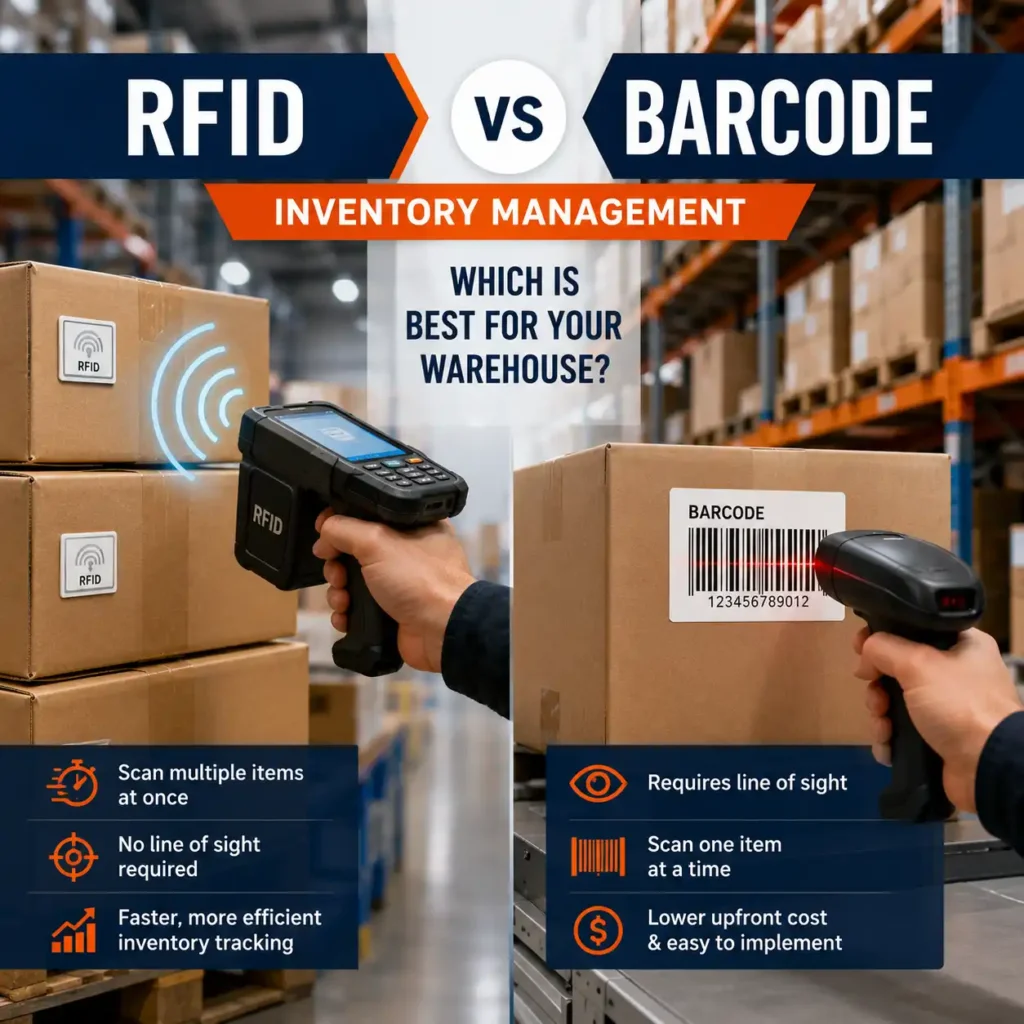
The main limitation of barcode inventory tracking is that it requires line-of-sight scanning — each label has to be scanned individually, one at a time, and a damaged or poorly printed barcode can cause read errors.
What Is RFID Inventory Tracking?
RFID (Radio-Frequency Identification) uses small chips (tags) that transmit data via radio waves to an RFID reader. Unlike barcodes, RFID tags don’t need to be seen or aligned with a scanner — a single reader can pick up hundreds of tags at once, even through boxes, pallets, or short distances.
There are three main types of RFID relevant to warehousing:
✓ Low-frequency (LF) RFID – short read range, used for simple asset tracking
✓ High-frequency (HF) RFID – medium range, common in retail and access control
✓ Ultra-high-frequency (UHF) RFID – long read range, the standard choice for RFID warehouse management and RFID pallet tracking
Because each RFID tag can carry a unique identifier and additional data (batch number, expiry date, location history), RFID asset tracking gives businesses far more visibility than a shared barcode ever could.
RFID vs Barcode: Key Differences at a Glance
Factor
Barcode
RFID
Scanning method
Line-of-sight, one at a time
No line-of-sight, multiple tags at once
Read speed
Slower for large volumes
Very fast — hundreds of tags per second
Data storage
Limited (usually just an ID number)
Higher — can store batch, location, history
Cost per unit
Very low (cents per label)
Higher (tags, readers, and middleware)
Durability
Can be damaged, torn, or smudged
More durable, some tags survive harsh conditions
Setup complexity
Simple, plug-and-play
Requires readers, antennas, and middleware
Best for
Small to mid-size operations, retail POS
High-volume, high-SKU, automated warehouses
RFID vs Barcode: Cost Comparison
Cost is usually the deciding factor in the barcode vs RFID debate.
Barcode systems are the cheapest way to label and track inventory. A barcode printer, scanner, and labels are a low upfront investment, and most WMS or ERP platforms integrate with barcode scanning out of the box.
RFID systems cost significantly more upfront. You’re paying for:
- RFID tags (more expensive than printed labels, especially for rugged or metal-mount tags)
- Fixed or handheld RFID readers (often 5–10x the cost of barcode scanners)
- Middleware software to filter reads and integrate with your WMS
However, the ROI on RFID usually shows up in lower labor costs, faster cycle counts, and reduced shrinkage — which is why large-scale distribution centres and high-value inventory operations often find the investment worthwhile despite the higher RFID implementation cost.
Accuracy and Speed: RFID vs Barcode
This is where RFID has a clear edge. Because RFID inventory tracking doesn’t rely on a human aiming a scanner at every single item, it removes most of the human error associated with manual barcode scanning. A single RFID reader can capture an entire pallet load in seconds — something that would take several minutes of manual barcode scanning.
Barcodes are still highly accurate when scanned correctly, but they depend on:
- Clear line of sight to the label
- The label being undamaged and readable
- Manual effort to scan each item
For businesses asking “is RFID better than barcode for inventory,” the honest answer is: RFID is faster and more automated, but barcode is simpler, cheaper, and perfectly accurate for lower-volume operations.
Applications: Where Each Technology Works Best
Barcode inventory system use cases:
- Retail labeling and point-of-sale
- Shipping and receiving documentation
- Compliance labeling
- Small to mid-size warehouses with moderate SKU counts
RFID warehouse management use cases:
- Automated, high-throughput warehouses
- Pallet and container tracking across large facilities
- Asset and tool tracking in industrial environments
- Manufacturing work-in-progress tracking
- Yard and fleet visibility
How RFID and Barcode Choice Affects Your Warehouse Racking Layout
This is the part most inventory-technology articles skip — but it matters just as much as the tracking system itself.
Your inventory tracking method directly influences how your warehouse racking system should be designed:
- Barcode-based warehouses typically need clear, well-lit aisles with easy staff access to each pallet position for manual scanning — which is why selective pallet racking (direct access to every pallet) is often the best fit.
- RFID-enabled warehouses can support higher-density storage layouts, since staff don't need direct line-of-sight to scan every item. This makes RFID a strong match for drive-in racking or VNA (Very Narrow Aisle) racking, where maximizing storage density matters more than individual pallet visibility.
- If you're planning RFID pallet tracking, your racking system should also account for reader placement — antennas are often mounted at aisle entry points or dock doors, which needs to be factored into your warehouse design from the start.
In short: choosing RFID or barcode isn’t just a software decision — it’s a warehouse design decision. Getting expert input on your racking layout before you invest in a tracking system can save significant rework costs later.
RFID vs Barcode for Warehouses in the UAE
The UAE’s logistics and retail sectors are scaling fast, and more warehouses across Dubai, Abu Dhabi, and Sharjah are evaluating smart inventory tracking to keep up with growth. A few things to consider if you’re comparing RFID inventory system UAE options against traditional barcode setups:
- High-volume distribution centres (3PL, e-commerce fulfillment) benefit most from RFID's speed and automation
- Retail and small-to-mid warehouses often get the best cost-to-benefit ratio from barcode systems
- Either way, your warehouse racking and shelving layout should be planned around your chosen tracking method — not the other way around
If you’re setting up or upgrading a warehouse in the UAE, it’s worth planning your racking system and inventory tracking approach together, rather than treating them as separate decisions.
Which One Should You Choose?
Ask yourself these questions:
✓ How many SKUs and how much inventory volume do you move daily? – High volume favors RFID; moderate volume favors barcode.
✓ What’s your budget for setup? – Barcode is far cheaper to implement.
✓ Do you need item-level visibility or batch tracking? – RFID’s unique tagging is better suited to this.
✓ Is labor cost or scanning time a major pain point? – RFID reduces manual scanning time significantly.
✓ What does your current racking layout support? – Dense storage (drive-in, VNA) pairs well with RFID; open-access layouts (selective racking) work fine with barcodes.
There’s no universal answer to “which is better, RFID or barcode” — it depends entirely on your operation’s scale, budget, and warehouse layout.
Frequently Asked Questions
Barcodes require direct line-of-sight scanning of one item at a time, while RFID uses radio waves to read multiple tags simultaneously without needing to see them directly.
Yes. RFID tags, readers, and middleware cost significantly more upfront than barcode labels and scanners, though RFID can reduce long-term labor costs
Not necessarily. Many businesses use a hybrid approach — barcodes for low-value or high-volume SKUs, and RFID for high-value assets or bulk pallet tracking.
Barcode systems are usually the better fit for small businesses and retail stores due to lower setup costs and simpler integration
Not always, but RFID often works best with higher-density racking layouts like drive-in or VNA racking, since it removes the need for direct visual access to every pallet.
Final Thoughts
Both RFID and barcode inventory management systems have a clear place in modern warehousing. Barcodes remain the practical, low-cost choice for smaller operations, while RFID delivers speed and automation that pays off at scale. Whichever you choose, make sure your warehouse racking and shelving layout is designed to support it — because the best inventory tracking system in the world won’t perform well in a warehouse that wasn’t built around it.
Looking to design a warehouse layout that works with your inventory tracking system? Talk to Rackpro’s team about racking solutions built for smarter, faster warehouse operations across the UAE.