
Warehouse Automation: The Complete Guide to Systems, Technology, Costs & Benefits
What is warehouse automation? Explore AS/RS, AGVs, pallet shuttles, robotic picking & WMS technology, real costs, ROI, and how to automate a warehouse in the UAE
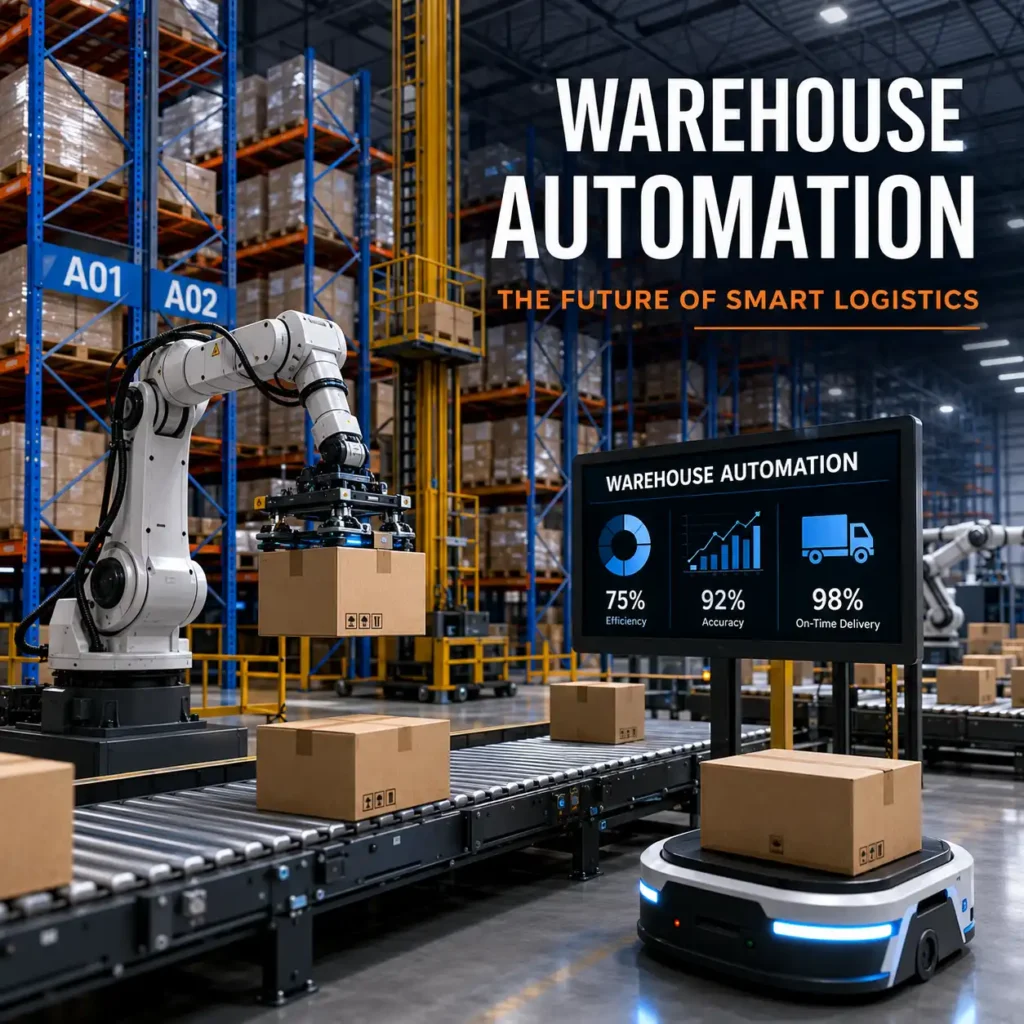
Warehouses across the UAE are under more pressure than ever. E-commerce order volumes keep climbing, labor costs keep rising, and customers expect same-day or next-day delivery as standard. Warehouse automation has become the answer for businesses that want to store more, pick faster, and cut errors without endlessly expanding floor space.
But “warehouse automation” isn’t one single technology — it’s an umbrella term covering everything from a simple conveyor belt to a fully robotic, goods-to-person picking facility. This guide breaks down what warehouse automation actually means, the systems available today, real costs and ROI, and how to decide what level of automation is right for your operation.
What Is Warehouse Automation?
Warehouse automation is the use of software, machinery, and robotics to perform warehouse tasks — such as storing, retrieving, picking, sorting, and moving inventory — with minimal human intervention. The goal of any automated warehouse system is to reduce manual labor, speed up order fulfillment, cut operational errors, and make better use of available storage space.
Automation exists on a spectrum. On one end, you have basic mechanization: conveyor belts, pallet flow racks, and barcode scanners. On the other end, you have fully automated warehouse systems where robots retrieve, pack, and load pallets with almost no human touchpoints. Most warehouses in the UAE sit somewhere in the middle — using a mix of smart racking, software, and selective automation to solve their biggest bottlenecks.
How Does Warehouse Automation Work?
At its core, warehouse automation technology works by connecting three layers:
✓ Physical infrastructure – racking, shuttles, conveyors, robots, and lifts that move or store goods
✓ Control software – a Warehouse Management System (WMS) or Warehouse Control System (WCS) that tells the machinery what to do and when.
✓ Data capture – barcodes, RFID tags, and sensors that track inventory in real time as it moves through the facility.
When an order comes in, the WMS calculates the most efficient path to retrieve the item, directs the automated equipment (a shuttle, robot, or conveyor) to fetch it, and updates inventory counts instantly. This is what allows a smart warehouse to process hundreds or thousands of orders per hour with a fraction of the manual labor a traditional warehouse would need.
Types of Warehouse Automation Systems
There isn’t a single “automation system” — there are several warehouse automation solutions, each solving a different problem. Here’s a breakdown of the most common ones.
01
Automated Storage and Retrieval Systems (AS/RS)
An automated storage and retrieval system (AS/RS) uses cranes, shuttles, or robotic mechanisms running on fixed rails to store and retrieve pallets or cartons from high-density racking — often without any human entering the aisle. AS/RS is ideal for warehouses with limited floor space but high ceiling height, since it can use vertical space far more efficiently than manual racking.
02
Pallet Shuttle Systems
A pallet shuttle system is a semi-automated solution where a remote-controlled shuttle moves along rails inside deep-lane racking to load and unload pallets, eliminating the need for forklifts to drive into the racking itself. It’s a popular middle-ground option for cold storage, FMCG, and beverage warehouses that need high-density storage with less mechanical complexity (and lower cost) than a full AS/RS.
03
Automated Guided Vehicles (AGVs)
Automated guided vehicles (AGVs) are driverless vehicles that follow fixed paths — magnetic strips, wires, or sensors embedded in the floor — to transport pallets and goods between fixed points in a warehouse.
04
Autonomous Mobile Robots (AMRs)
Autonomous mobile robots (AMRs) are the more flexible cousin of AGVs. Instead of following a fixed path, AMRs use onboard sensors, cameras, and mapping software to navigate dynamically around a warehouse, adjusting their route in real time to avoid obstacles or people. AMRs are increasingly popular because they’re faster to deploy and easier to reconfigure than AGVs.
05
Conveyor Systems
Conveyor systems for warehouses move goods between zones — from receiving to storage, or from picking to packing — without manual carrying. Modern conveyor systems are often integrated with sortation technology that automatically routes packages to the correct dispatch lane based on barcode or RFID data.
06
Automated Picking Systems & Goods-to-Person Picking
Automated picking systems reduce the walking time that eats up a huge share of a picker’s shift. The most common model is goods-to-person picking, where shelving units or totes are automatically brought to a stationary picker, rather than the picker walking to the shelf. This alone can cut picking time significantly in high-SKU operations like e-commerce fulfillment.
07
Vertical Lift Modules (VLM)
A vertical lift module (VLM) is an enclosed automated storage unit that uses a central extractor to retrieve trays of stock and deliver them to an operator at an ergonomic access point. VLMs are popular for storing small, high-value, or high-SKU-count items such as spare parts, electronics, and documents, since they use vertical building height instead of floor footprint.
08
Robotic Palletizing
Robotic palletizing uses robotic arms to stack cartons or boxes onto pallets in optimized patterns, replacing manual stacking at the end of a production or packing line. This is especially valuable in FMCG and manufacturing environments with high-volume, repetitive palletizing tasks.
09
Warehouse Management Systems (WMS)
A warehouse management system (WMS) is the software backbone tying every automated component together. It tracks inventory location, manages order picking logic, integrates with automated equipment, and provides the real-time visibility that makes automation actually work. Even warehouses that aren’t ready for robotics can get major efficiency gains from a good WMS alone.
Benefits of Warehouse Automation
The benefits of warehouse automation go beyond simply “doing things faster.” Businesses typically see improvements across several areas:
Higher storage density
Vertical, automated systems use cubic space far more efficiently than manual racking with wide aisles.
Faster order fulfillment
Automated picking and retrieval cut the walking and searching time that dominates manual operations.
Fewer errors
Barcode and RFID-driven picking dramatically reduces mis-picks and inventory discrepancies.
Lower long-term labor dependency
Automation reduces reliance on large seasonal or shift-based labor pools, which is a growing concern in UAE logistics hubs.
Improved safety
Fewer forklifts operating in narrow aisles and fewer manual lifts means fewer workplace incidents.
Better inventory accuracy
Real-time tracking through a WMS virtually eliminates the “phantom stock” problem common in manual warehouses.
Warehouse Automation Cost: What to Expect
Warehouse automation cost varies enormously depending on scope — this is the single most common question we get from UAE warehouse operators exploring automation.
✓ Full automation (AS/RS, AMR fleets, robotic picking and palletizing)- the highest upfront investment, typically justified only at high throughput volumes.
Because pricing depends heavily on facility size, throughput requirements, and existing infrastructure, the most reliable way to budget is a site-specific automation assessment rather than a generic quote — costs for two “similar-sized” warehouses can differ significantly based on ceiling height, SKU count, and order profile.
Warehouse Automation ROI: When Does It Pay Off?
Warehouse automation ROI is driven by three factors: labor savings, space savings, and error reduction. A rough way to evaluate it:
✓ Calculate current cost per order picked – (labor + error/returns cost).
✓ Estimate the automated cost per order picked – post-implementation.
✓ Divide the automation investment by the monthly savings – to get a payback period.
Operations with high order volume, high labor costs, or severe space constraints typically see the fastest payback — sometimes under 2–3 years for semi-automated systems like pallet shuttles, and longer for full AS/RS installations. Businesses with low, seasonal, or highly variable order volumes often get better ROI from smart racking design and a WMS than from heavy robotics investment.
Warehouse Automation vs Manual Warehouse Operations
Factor
Manual Warehouse
Automated Warehouse
Storage density
Lower (wide aisles needed)
Higher (narrow aisle / vertical systems)
Labor dependency
High
Lower, more consistent
Picking speed
Limited by walking time
Significantly faster
Error rate
Higher (manual entry/picking)
Lower (barcode/RFID driven)
Upfront cost
Low
Moderate to high
Flexibility to reconfigure
High
Lower (fixed infrastructure) for AS/RS; higher for AMRs
Best suited for
Low-to-medium volume, variable SKUs
High volume, repetitive tasks
Neither model is universally “better” — warehouse automation vs manual warehouse is really a question of order volume, labor cost trends, and available space.
AS/RS vs Traditional Racking — And Pallet Shuttle vs Drive-In
A common question we get is AS/RS vs traditional racking: should you invest in a crane-based automated system, or stick with proven static racking?
✓ Traditional selective racking – offers direct access to every pallet and the lowest cost per storage position — ideal for diverse SKUs with regular turnover.
✓ AS/RS – trades some flexibility for massive space efficiency and labor reduction — best for high-volume, repetitive SKUs in space-constrained facilities.
Similarly, pallet shuttle vs drive-in racking comes down to speed and damage risk: drive-in racking requires forklifts to enter the racking structure (slower, higher damage risk to structure and product), while a pallet shuttle system automates that movement, reducing both forklift traffic and product damage — at a higher upfront cost.
Warehouse Automation for E-Commerce
Warehouse automation for e-commerce is often the strongest business case for automation, because e-commerce fulfillment involves high SKU counts, small order sizes, and tight delivery windows — exactly the conditions where goods-to-person picking, conveyor sortation, and AMRs deliver the biggest efficiency gains. Even mid-sized e-commerce operations in the UAE are increasingly adopting semi-automated picking and sortation to keep pace with same-day delivery expectations.
Warehouse Automation for Cold Storage
Warehouse automation for cold storage solves a specific problem: minimizing the time staff spend inside sub-zero environments. Automated pallet shuttles and AS/RS systems are particularly valuable in cold chain warehouses because they reduce labor exposure to extreme temperatures, cut energy costs by enabling higher storage density (less refrigerated volume per pallet stored), and maintain consistent stock rotation through automated FIFO/FEFO logic.
Warehouse Automation for Small Business — Do You Really Need It?
Warehouse automation for small business doesn’t have to mean robots and conveyor lines. For smaller operations, “automation” often means:
- Implementing a cloud-based WMS for real-time inventory tracking
- Using barcode scanning instead of manual data entry
- Choosing racking systems designed for fast, organized picking (e.g., pick modules, mezzanine floors for slow-moving stock)
Full robotic automation typically only makes financial sense once order volumes and labor costs justify the investment — for many small and mid-sized UAE businesses, smart racking design plus a WMS delivers most of the efficiency gain at a fraction of the cost.
Warehouse Automation Trends 2026 & The Future of Warehousing
The future of warehouse automation is being shaped by a few clear trends heading into 2026:
✓ Wider adoption of AMRs over fixed AGVs – thanks to faster deployment and lower reconfiguration cost.
✓ Hybrid human-robot picking models – where robots handle travel and humans handle final item selection — a middle ground that’s cheaper than full robotic picking.
✓ Automation-ready racking design – warehouses increasingly design their racking layouts from day one to support future automation retrofits, avoiding costly structural rework later.
✓ Growing focus on Industry 4.0 warehousing – across UAE logistics and free zones, driven by national initiatives to position the UAE as a regional logistics and manufacturing hub.
How to Automate a Warehouse: Step-by-Step
If you’re wondering how to automate a warehouse, the process generally follows these stages:
Audit current operations
Map order volume, SKU count, pick paths, and existing bottlenecks.
Define the problem you’re solving
Space constraints, labor cost, error rate, or throughput speed each point to different solutions.
Choose the right automation level
WMS-only, semi-automated (shuttles/conveyors), or full robotics.
Design racking and layout around the chosen system
Automation only works if the physical racking infrastructure is compatible.
Pilot before full rollout
Test automation in one zone or one product line before committing facility-wide.
rain staff and integrate systems
Automation shifts labor from manual tasks to system oversight, requiring new training.
Warehouse Automation in the UAE
Warehouse automation UAE demand is accelerating fast, driven by the country’s position as a regional logistics hub, rising e-commerce penetration, and government initiatives pushing Industry 4.0 adoption across manufacturing and logistics sectors. Smart warehouse Dubai projects and automated storage systems Abu Dhabi installations are becoming increasingly common among 3PLs, FMCG distributors, and cold chain operators looking to stay competitive regionally.
That said, most UAE warehouses aren’t jumping straight to full robotic automation — the more common path is upgrading racking infrastructure to be automation-ready (correct beam spacing, aisle widths, and load ratings for future shuttle or AS/RS integration) while automating the highest-impact areas first, such as picking or high-density storage zones.
This is where the foundation matters most: no automated system — whether it’s a pallet shuttle, AS/RS, or AMR fleet — can perform well on racking that wasn’t engineered to support it. Getting the underlying heavy-duty pallet racking, drive-in racking, or VNA racking design right from the start is what makes automation retrofits possible down the line — without costly structural rebuilds.
Frequently Asked Questions
Warehouse automation is the use of technology — software and machinery — to perform warehouse tasks like storing, picking, and moving goods with less manual labor.
Common warehouse automation examples include pallet shuttle systems, AS/RS cranes, conveyor and sortation lines, robotic palletizers, AMRs, and WMS software.
In the warehouse robots vs human workers debate, most real-world deployments are hybrid — robots handle repetitive travel and lifting tasks, while humans handle judgment-based tasks like quality checks, exception handling, and final item selection.
Not always at the robotics level — but a WMS and automation-ready racking design usually pay for themselves quickly even for smaller operations.
It depends on scope — from relatively low-cost WMS software implementations to significant investments for full AS/RS or robotic picking systems. A site assessment is the only reliable way to get an accurate figure.
Final Thoughts
Warehouse automation isn’t an all-or-nothing decision. The smartest approach for most UAE businesses is to start with the racking and layout foundation, add a WMS for visibility, and automate the highest-impact zone — whether that’s picking, storage density, or palletizing — before scaling further.
If you’re evaluating whether your current racking setup can support future automation, get in touch with RackPro for a warehouse design consultation across Dubai, Abu Dhabi, Sharjah, and Ajman.