
Supply Chain Management: The Complete Guide (Process, Types, Technology & UAE Best Practices)
Learn what supply chain management is, its process, types, technology, KPIs, and best practices for UAE warehouses. A complete 2026 guide by RackPro Shelving.
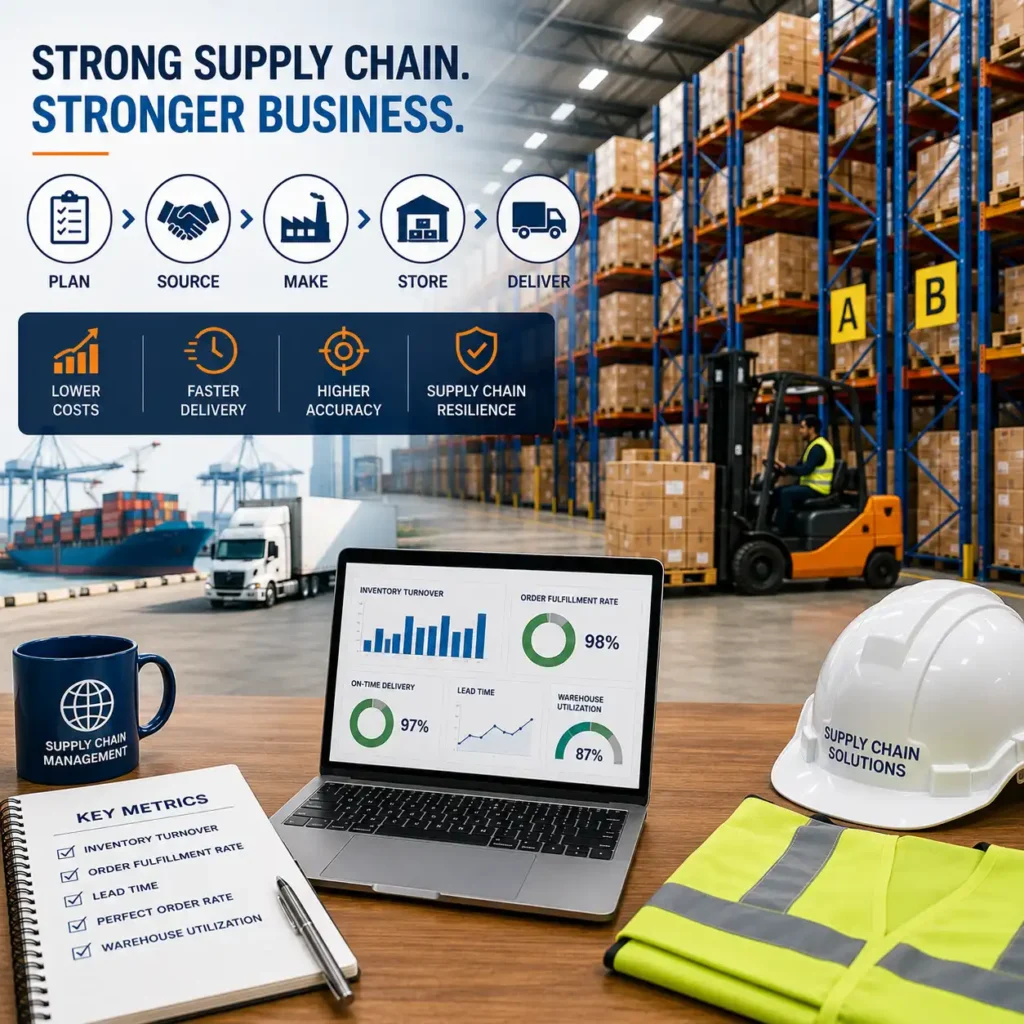
Every product a business sells — from a bag of rice to a steel beam — travels through a chain of people, processes, and places before it reaches the customer. Supply chain management (SCM) is the discipline of planning, coordinating, and controlling that entire journey, from raw material to final delivery.
For businesses operating in the UAE — where Dubai and Abu Dhabi serve as major re-export and logistics hubs for the Middle East, Africa, and South Asia — supply chain management isn’t just a back-office function. It’s a competitive advantage. Companies that manage their supply chains well move goods faster, spend less on storage and transport, and keep customers happier than competitors who don’t.
This guide covers everything you need to know: what supply chain management is, how the process works, the different types of supply chain models, the technology driving modern supply chains, common challenges, key roles, and the metrics that measure success — with a specific look at how warehousing and storage infrastructure fit into the picture.
What Is Supply Chain Management?
Supply chain management is the end-to-end coordination of all activities involved in sourcing raw materials, converting them into finished goods, and delivering those goods to the end customer. It covers five core areas: planning, sourcing, production, delivery (logistics), and returns.
Unlike logistics, which focuses specifically on the movement and storage of goods, supply chain management is the bigger picture — it includes supplier relationships, procurement decisions, production scheduling, demand forecasting, inventory control, warehousing, transportation, and after-sales returns, all working together as one system.
A simple way to think about it: if logistics is one department, supply chain management is the entire organization working in sync — suppliers, manufacturers, warehouses, distributors, and retailers — to get the right product, to the right place, at the right time, at the lowest possible cost.
Why Supply Chain Management Matters
A well-managed supply chain directly affects a company’s bottom line and customer satisfaction. Businesses with strong supply chain management typically see:
In a region like the UAE, where many businesses import materials and re-export finished goods, supply chain management determines whether a company can compete on price and speed in regional and global markets.
The Supply Chain Management Process: 5 Core Stages
01
Supply Chain Planning
This is the strategic foundation of the entire chain. Supply chain planning involves forecasting demand, setting production targets, and deciding how much inventory to hold and where. Good planning relies heavily on demand forecasting — using historical sales data, market trends, and seasonality to predict what customers will need next.
02
Sourcing and Procurement
The procurement process covers identifying suppliers, negotiating contracts, and purchasing raw materials or components. A solid sourcing strategy balances cost, quality, reliability, and lead time — and increasingly, sustainability credentials — when selecting suppliers.
03
Manufacturing and Production
Raw materials are converted into finished products here. This stage focuses on production scheduling, quality control, and capacity planning to meet the demand forecasts set during the planning stage.
04
Delivery and Logistics
This is where warehousing and inventory management come in. Finished goods are stored, picked, packed, and shipped to distributors, retailers, or directly to customers. Efficient warehouse layout and the right storage infrastructure — pallet racking, shelving, and mezzanine systems — directly determine how quickly and accurately this stage runs.
05
Returns Management (Reverse Logistics)
Handling returned, damaged, or excess goods is often overlooked but plays a major role in customer satisfaction and cost control. A clear returns process reduces losses and helps identify recurring quality or fulfillment issues
Types of Supply Chain Models
Not every business runs its supply chain the same way. The right supply chain model depends on the industry, product type, and demand pattern.
Lean Supply Chain
Focused on eliminating waste and minimizing costs. Best suited to businesses with predictable, stable demand — such as manufacturers producing standardized products at high volume.
Agile Supply Chain
Built for speed and flexibility. Agile supply chains can quickly adapt to changing demand or market conditions, making them ideal for industries with unpredictable or fast-changing demand, like fashion or electronics.
Green (Sustainable) Supply Chain
Prioritizes environmental responsibility — reducing carbon footprint, using recyclable packaging, and choosing suppliers with sustainable practices. This model is gaining traction across the UAE as more businesses align with national sustainability goals.
Hybrid Models
Many companies blend lean and agile approaches — running a lean core supply chain while keeping agile capacity for peak seasons or urgent orders.
Supply Chain Management vs Logistics: What's the Difference?
This is one of the most searched questions on the topic, and the confusion is understandable since the two overlap heavily.
Supply Chain Management
Logistics
The entire network: suppliers, manufacturers, warehouses, distributors, retailers
One function within that network
Includes procurement, production, planning, and returns
Focused on transportation, warehousing, and distribution
Strategic, long-term focus
Operational, day-to-day focus
Goal: optimize the whole system
Goal: move and store goods efficiently
In short: logistics is a part of supply chain management, not the other way around.
Supply Chain Management Software and Technology
Modern supply chains run on data, and the right technology stack can be the difference between a reactive operation and a predictive one.
- ERP Systems (SAP, Oracle, Microsoft Dynamics)
Integrate procurement, inventory, finance, and production data into a single platform
- Warehouse Management Systems (WMS)
Track inventory location, automate picking and packing, and optimize storage layout in real time
- Supply Chain Automation
Barcode scanning, RFID tracking, and automated storage and retrieval systems (AS/RS) reduce manual errors and speed up operations
- Demand Planning Software
Uses AI and historical data to improve forecast accuracy
- Transportation Management Systems (TMS)
Optimize shipping routes and carrier selection
For UAE businesses scaling up, pairing a WMS with the right physical infrastructure — properly designed pallet racking and shelving systems — is what actually makes automation and inventory accuracy possible in the warehouse itself. Software can tell you what’s in stock; the right racking system is what makes that stock findable, safe, and fast to move.
Common Supply Chain Challenges (and How to Solve Them)
✓ Supply Chain Risk Management – Every supply chain carries risk — from supplier failure to demand volatility. Solution: build risk assessments into supplier selection and maintain contingency plans for key materials.
✓ Supply Chain Bottlenecks – Bottlenecks often occur at receiving, storage, or picking stages inside the warehouse. Solution: redesign warehouse layout and racking configuration to remove congestion points and improve flow.
✓ Poor Inventory Visibility – Not knowing exact stock levels leads to overstocking or stockouts. Solution: implement a WMS integrated with barcode or RFID scanning.
✓ How to Improve Supply Chain Efficiency –
The most effective efficiency gains typically come from three areas: better demand forecasting, warehouse layout optimization, and stronger supplier collaboration. Small improvements at each stage compound into significant cost and time savings across the full chain.
Key Roles in Supply Chain Management
✓ Supply Chain Manager – Oversees the entire chain — planning, sourcing, production, and logistics — to hit cost, speed, and quality targets
✓ Procurement Manager – Focused specifically on sourcing suppliers and negotiating purchase terms (supply chain vs procurement: procurement is one function within the broader supply chain role)
✓ Logistics Coordinator – Manages transportation and warehousing operations
✓ Demand Planner – Forecasts future demand to guide production and inventory decisions
✓ Warehouse Manager – Runs day-to-day storage operations, inventory accuracy, and staff coordination
Supply Chain Management in the UAE
The UAE’s position as a global logistics and re-export hub — anchored by Jebel Ali Port, Khalifa Port, and major free zones — makes supply chain management a critical function for businesses across Dubai, Abu Dhabi, Sharjah, and beyond.
Companies operating supply chain and logistics operations in the UAE typically focus on:
✓ Warehousing and storage – near key ports and free zones for faster distribution
✓ Multi-modal logistics – combining sea, air, and road freight for regional distribution
✓ Compliance – with UAE customs and free zone regulations
✓ Scalable storage infrastructure – that can expand as trade volumes grow
Whether you’re a distributor in Dubai, a manufacturer in Abu Dhabi, or a retailer supplying across the Emirates, the strength of your physical warehousing setup directly supports every other part of your supply chain strategy.
The Role of Warehousing in Supply Chain Efficiency
Warehousing sits at the intersection of production and delivery — and it’s often where supply chain efficiency is won or lost. A poorly organized warehouse creates bottlenecks no amount of software can fully fix.
Three factors determine how well a warehouse supports the wider supply chain:
✓ Storage density – how much inventory can be held without wasting floor space (heavy-duty pallet racking and drive-in racking systems maximize this)
✓ Accessibility – how quickly staff can locate and retrieve stock (selective racking and clear aisle layouts improve pick speed)
✓ Scalability – whether the racking and shelving system can expand as inventory volume grows
This is why supply chain management and warehouse design are inseparable in practice. A business can have perfect demand forecasts and the best ERP system available, but if the physical storage layout can’t keep pace, the whole chain slows down.
Supply Chain KPIs and Metrics That Matter
Tracking the right metrics is how businesses know if their supply chain is actually improving.
✓ Inventory Turnover Ratio – How many times inventory is sold and replaced over a period — higher turnover generally signals efficient inventory management
✓ Order Fulfillment Rate – The percentage of orders delivered complete and on time
✓ Lead Time – The time between placing an order and receiving it — shorter lead times mean a more responsive supply chain
✓ Perfect Order Rate – Orders delivered on time, complete, and without damage
✓ Warehouse Space Utilization – How efficiently available storage space is being used — a key metric directly influenced by racking system design
Reviewing these KPIs regularly helps businesses identify exactly where in the chain — planning, sourcing, production, or warehousing — improvements will have the biggest impact.
Frequently Asked Questions
Supply chain management is the process of coordinating everything involved in getting a product from raw material to the end customer — including sourcing, production, warehousing, and delivery.
Planning, sourcing, manufacturing, delivery (logistics), and returns management.
No. Logistics is one part of supply chain management, specifically covering transportation and warehousing. Supply chain management is the broader system, including procurement, production, and planning.
Retail, manufacturing, FMCG, construction, and logistics-heavy industries rely most heavily on structured supply chain management, though virtually every industry benefits from it.
Warehousing directly impacts inventory accuracy, order fulfillment speed, and storage costs — making it one of the most influential stages in the overall supply chain.
Final Thoughts
Supply chain management is the system that keeps modern commerce moving — and in a trade and logistics hub like the UAE, getting it right is a genuine competitive edge. While software, forecasting, and supplier relationships get most of the attention, the physical foundation of any supply chain is the warehouse itself.
At RackPro Shelving, we help UAE businesses strengthen the warehousing link in their supply chain with heavy-duty pallet racking, drive-in systems, VNA racking, cantilever racking, and shelving solutions designed, supplied, and installed across all Emirates. If your supply chain is only as strong as your storage setup, get in touch with our team to design a system built for how your business actually moves inventory.