
What is 3PL? A Complete Guide to Third-Party Logistics (2026)
What is 3PL? Learn the meaning of third-party logistics, how it works, 3PL vs 4PL, benefits, costs, and how to set up a 3PL warehouse in the UAE.
If you’ve ever ordered something online and wondered how it landed on your doorstep within 24 hours, chances are a 3PL made it happen. For businesses across the UAE — from e-commerce brands in Dubai to manufacturers in Abu Dhabi — understanding what 3PL means and how it works is the first step to building a faster, leaner, and more scalable supply chain.
In this guide, we’ll cover the 3PL meaning, how it compares to 1PL, 2PL, 4PL and 5PL, the services a 3PL provider offers, the benefits and drawbacks of outsourcing logistics, and how to set up (or choose) a 3PL warehouse in the UAE — including the racking systems that make 3PL warehouses run efficiently.
What Does 3PL Stand For?
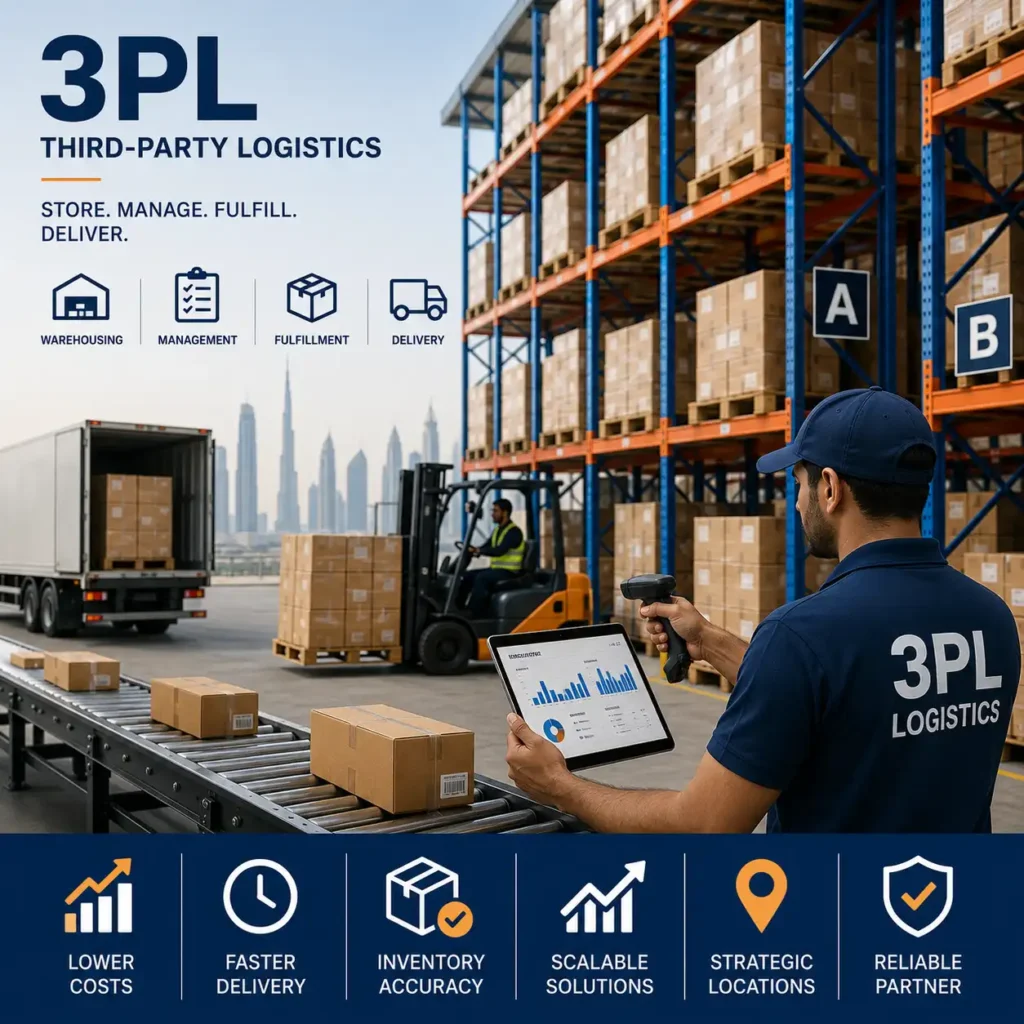
3PL stands for Third-Party Logistics. It refers to a company that manages outsourced logistics and supply chain operations on behalf of another business. Instead of a brand building, staffing, and running its own warehouse, it partners with a 3PL provider to handle the physical side of getting products from storage to the customer’s door.
3PL Meaning in Simple Terms
In plain terms, third party logistics means handing over your warehousing and distribution work to a specialist company so you can focus on sales, product, and growth — while the 3PL focuses on storage, packing, and shipping.
What Does a 3PL Company Actually Do?
A 3PL provider typically manages some or all of the following:
✓ Warehousing – Storing inventory in a secure, organized facility
✓ Inventory management – Tracking stock levels in real time
✓ Order fulfillment – Picking, packing, and preparing orders for shipment
✓ Freight forwarding – Managing inbound and outbound freight
✓ Cross-docking – Transferring goods directly from inbound to outbound transport with little to no storage time
✓ Last-mile delivery – Getting the product to the final customer
✓ Returns processing (reverse logistics) – Handling customer returns and restocking
This combination of services is why 3PL fulfillment services have become the backbone of e-commerce and retail distribution across the UAE and globally.
The Logistics Ladder: 1PL vs 2PL vs 3PL vs 4PL vs 5PL
Understanding 3PL vs 4PL (and the rest of the “PL” family) helps clarify exactly where a 3PL fits in the supply chain.
Level
Name
What It Means
1PL
First-Party Logistics
The manufacturer or shipper moves and stores its own goods, with no outside logistics help
2PL
Second-Party Logistics
An asset-based carrier (a shipping line, airline, or trucking company) handles transportation only
3PL
Third-Party Logistics
An outsourced provider manages warehousing, fulfillment, and distribution
4PL
Fourth-Party Logistics
A lead logistics provider that manages and coordinates multiple 3PLs on a client’s behalf
5PL
Fifth-Party Logistics
Manages entire supply chain networks across multiple 4PLs, common in large-scale e-commerce
3PL vs 4PL: What's the Real Difference?
The core difference in the 3PL vs 4PL comparison is control and scope:
- A 3PL physically handles your goods — it owns or leases the warehouse, racking, staff, and trucks.
- A 4PL doesn't necessarily touch your goods at all. It acts as a strategic layer above multiple 3PLs, coordinating and optimizing the entire logistics network.
Most small and mid-sized UAE businesses work directly with a 3PL. Larger enterprises with complex, multi-country supply chains sometimes add a 4PL layer on top to manage several 3PL partners at once.
3PL vs In-House Warehousing: Which Is Right for You?
One of the biggest decisions a growing business faces is 3PL vs in-house warehousing — should you outsource, or build your own storage and fulfillment operation?
Factor
3PL (Outsourced)
In-House Warehousing
Upfront cost
Low — no need to buy or lease a facility
High — requires property, racking, and equipment
Control
Limited — you rely on the 3PL’s processes
Full control over operations and quality
Scalability
Easy to scale up/down with demand
Requires new space, racking, and staff to scale
Speed to launch
Fast — plug into existing infrastructure
Slower — requires setup time
Best for
Startups, seasonal businesses, e-commerce brands
Established businesses with stable, high-volume storage needs
Many UAE businesses start with a 3PL and transition to an in-house warehouse once volumes justify the investment in property, staff, and pallet racking systems.
Benefits of Using a 3PL
✓ Lower capital investment – No need to buy warehouse space or racking equipment
✓ Faster market entry – Plug into an existing network instead of building one
✓ Scalability – Expand or reduce storage based on seasonal demand
✓ Expertise – 3PLs specialize in logistics, so processes are typically more efficient
✓ Focus – Your team can focus on product and sales instead of warehouse operations
3PL Companies in the UAE: What to Look For
The UAE — particularly Dubai and Abu Dhabi — has become a major logistics hub due to its ports, free zones, and central location between Asia, Europe, and Africa. When evaluating 3PL companies in UAE, businesses should look at:
✓ Warehouse location – Proximity to Jebel Ali Port, Dubai South, or Khalifa Industrial Zone (KIZAD)
✓ Storage capacity and racking infrastructure – Can the facility handle your product type (palletized goods, small parcels, cold storage, bulky items)?
✓ Technology – Real-time inventory tracking and integration with your sales channels
✓ Pricing mode – Per-pallet, per-order, or per-square-foot storage fees
Whether you’re searching for 3PL warehouse Dubai options or 3PL warehousing Abu Dhabi, the same fundamentals apply: location, infrastructure, and reliability.
How to Set Up a 3PL Warehouse in the UAE
If you’re a logistics company (rather than a brand looking to outsource), setting up your own 3PL warehouse involves a few key steps:
✓ Choose a location – Near ports, airports, or major highways for fast distribution across the Emirates
✓ Secure the facility and trade license – Free zone or mainland, depending on your client base
✓ Design the warehouse layout – Plan for receiving, storage, picking, packing, and dispatch zones
✓ Install the right racking system – This is where storage efficiency is won or lost (see below)
✓ Implement a Warehouse Management System (WMS) – For real-time inventory and order tracking
✓ Hire and train staff – For picking, packing, forklift operation, and safety compliance
Pallet Racking for Fulfillment Centers and 3PL Warehouses
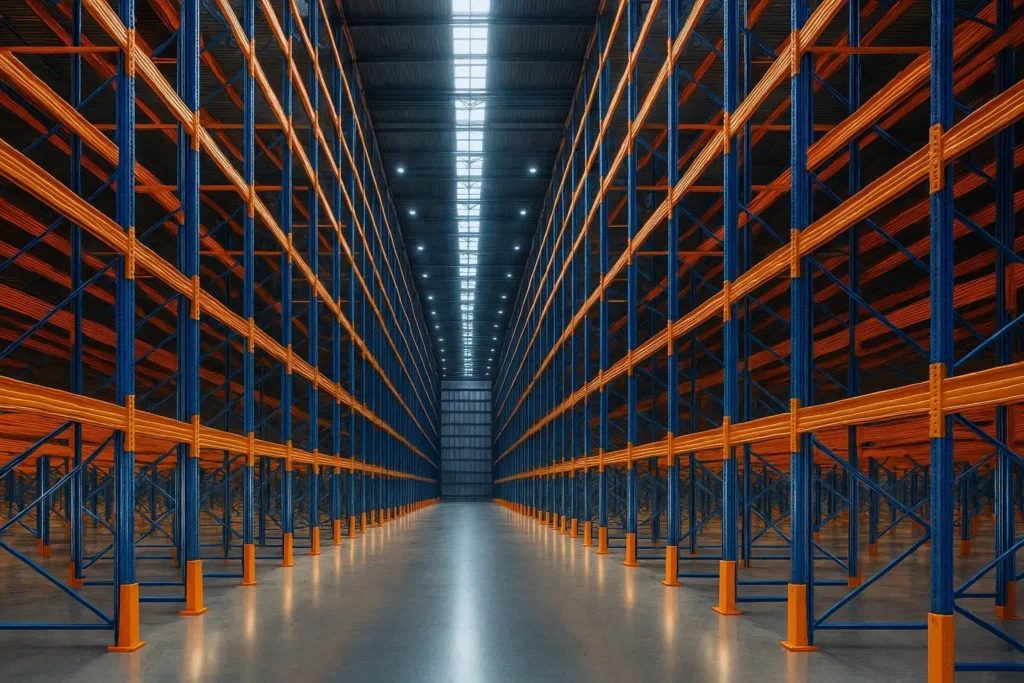
Since a 3PL warehouse often stores inventory for multiple clients with different product types, the racking system needs to be flexible, space-efficient, and built for high pallet turnover. Common choices include:
✓ Heavy-duty pallet racking – For general, high-turnover fulfillment storage with direct access to every pallet
✓ Drive-in pallet racking – For high-density storage of single-SKU or bulk client inventory
✓ VNA (Very Narrow Aisle) racking – To maximize storage density in space-constrained UAE warehouses
✓ Cantilever racking – For clients storing long or irregularly shaped goods
Choosing the right mix of racking systems directly affects how much inventory a 3PL warehouse can hold — and how efficiently orders can be picked and shipped.
Cost of Setting Up a 3PL Warehouse in the UAE
The cost of setting up a 3PL warehouse in UAE depends on several factors:
✓ Facility size and location – (free zone vs mainland, port proximity)
✓ Racking system type and density – (selective racking is cheaper upfront; VNA and drive-in systems cost more but store significantly more per square meter)
✓ Fit-out costs – including compliance with UAE fire safety and racking safety standards
Because racking design has a direct impact on both storage capacity and long-term operational cost, it’s worth getting a professional warehouse design and racking consultation before finalizing your budget.
Frequently Asked Questions
3PL is a company that stores, packs, and ships products on behalf of another business, so that business doesn't need its own warehouse.
A 3PL physically manages warehousing and fulfillment. A 4PL sits above multiple 3PLs, coordinating the overall logistics strategy without necessarily handling goods itself.
Usually yes, in the short term — 3PL avoids the capital cost of buying property and racking. Over time, in-house warehousing can become more cost-effective for businesses with large, stable volumes
Yes. The UAE's port infrastructure and free zones have made it a major hub for 3PL and fulfillment operations across the Middle East.
It depends on the inventory mix. Most 3PLs use a combination of heavy-duty selective racking for general storage and drive-in or VNA racking for high-density, single-SKU client inventory.
Final Thoughts
Whether you’re a brand deciding between 3PL vs in-house warehousing, or a logistics company planning to set up a 3PL warehouse in the UAE, the right racking infrastructure is what turns warehouse space into real storage capacity and fulfillment speed.
Need help designing a racking system for a 3PL or fulfillment warehouse in the UAE? Get in touch with RackPro for a free warehouse design consultation across Dubai, Abu Dhabi, Sharjah, and all emirates.