
Automated Storage and Retrieval Systems: Complete Guide
Discover how automated storage and retrieval systems (AS/RS) work, their key advantages, types, and how they can transform your warehouse operations.
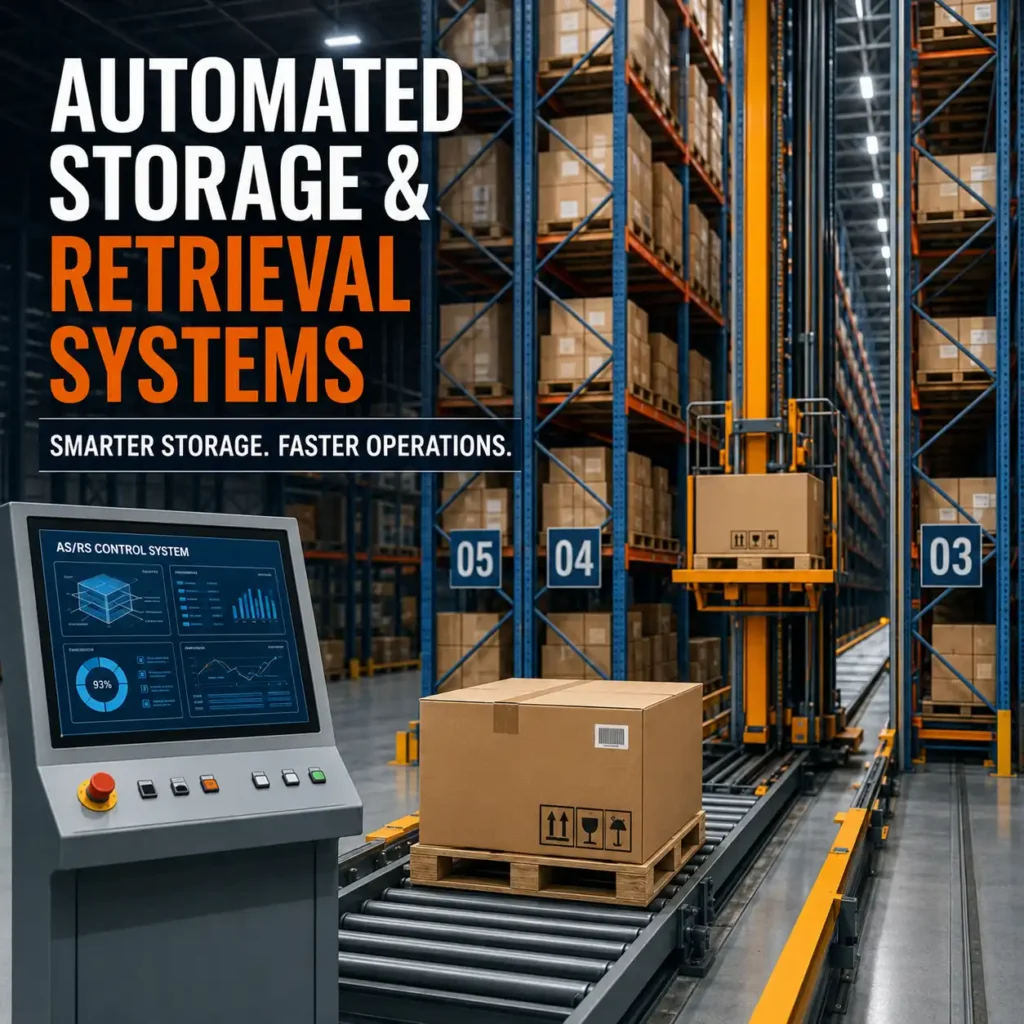
The pressure on warehouses today has never been greater. Faster delivery expectations, rising labor costs, shrinking floor space, and increasingly complex supply chains are pushing businesses to rethink how they store and move goods. For many operations, the answer lies in automation — specifically, automated storage and retrieval systems.
An automated storage and retrieval system, commonly known as AS/RS, is a technology-driven logistics solution that handles the storage, movement, and retrieval of goods with minimal human intervention. Using equipment such as stacker cranes, conveyors, electrified monorails, and shuttle systems, AS/RS solutions manage warehouse operations around the clock — accurately, efficiently, and at scale.
In a world shaped by Logistics 4.0, where data, connectivity, and automation define competitive advantage, AS/RS technology has moved from a luxury reserved for enterprise giants to an increasingly accessible solution for mid-sized and growing operations. Whether you are planning to automate an existing facility or build a new warehouse from the ground up, understanding how these systems work — and what they can do for your business — is essential.
This guide covers everything you need to know: the core advantages of AS/RS, the data you need to gather before implementation, the different types of systems available, and real-world examples of businesses that have transformed their operations through automation.
What Is an Automated Storage and Retrieval System (AS/RS)?
An automated storage and retrieval system is a set of computer-controlled mechanisms designed to automatically place and retrieve loads from defined storage locations within a warehouse or distribution center. The system operates through a combination of hardware — including stacker cranes, conveyors, and robotic shuttles — and software, typically a warehouse management system (WMS) that directs every movement and maintains real-time inventory records.
Unlike traditional warehouses where human operators drive forklifts and pick orders manually, AS/RS solutions execute storage and retrieval tasks autonomously. Operators manage exceptions, monitor system performance, and focus on higher-value tasks rather than repetitive physical handling.
How AS/RS Works
The core workflow of an automated storage and retrieval system follows a consistent pattern. When goods arrive at the warehouse, they are identified, logged into the WMS, and placed onto a conveyor or loading station. From there, automated handling equipment — most commonly a stacker crane — transports the load to its designated storage location. When a retrieval order is triggered, the system locates the item, the stacker crane retrieves it, and the goods are transported automatically to the dispatch or picking area.
Every movement is tracked in real time, giving logistics managers complete visibility over inventory at all times. This continuous, automated cycle operates 24 hours a day, 7 days a week, without fatigue, error, or downtime.
The Role of Warehouse Management Systems in AS/RS
No automated storage and retrieval system functions effectively without a robust warehouse management system at its core. The WMS acts as the brain of the operation — assigning storage locations, directing handling equipment, managing inbound and outbound flows, tracking inventory by SKU, and generating performance reports. The WMS also maintains a complete movement history for every product, enabling rigorous traceability and audit capability. For businesses in regulated industries like pharmaceuticals, food and beverage, or electronics, this traceability is not just valuable — it is essential.
Key Advantages of Automated Storage and Retrieval Systems
Understanding the benefits of AS/RS is critical before committing to an investment of this scale. The advantages span operational efficiency, cost reduction, safety, and long-term scalability.
Continuous Productivity and High Availability
One of the most significant advantages of automated storage and retrieval systems is their ability to operate continuously without interruption. Stacker cranes and conveyors do not take breaks, work shifts, or call in sick. They are available 24 hours a day, 365 days a year, ensuring that inflows and outflows of goods happen on schedule regardless of the time of day or staffing levels.
For businesses with high order volumes, seasonal peaks, or global distribution requirements, this round-the-clock availability is a transformational capability. It removes the ceiling that human labor places on throughput and allows warehouses to scale operations dynamically.
Reduced Labor Costs
Automated handling equipment takes over the repetitive, physically demanding tasks that previously required large teams of forklift operators, order pickers, and warehouse staff. This does not mean eliminating the workforce — it means redeploying people to more complex, value-adding roles that require human judgment, problem-solving, and customer interaction.
Over time, the reduction in direct labor costs and the elimination of overtime, shift premiums, and recruitment expenses generate substantial savings. For high-volume operations, labor cost reduction alone is often enough to justify the investment in AS/RS technology.
Lower Maintenance and Equipment Costs
Manual warehouse operations place significant wear and tear on handling equipment. Forklifts operated by humans are prone to collisions, overloading, and improper use — all of which accelerate maintenance cycles and increase repair costs. Automated handling equipment, by contrast, operates within tightly controlled parameters. Movements are precise, loads are handled correctly every time, and the system does not deviate from its programmed protocols. The result is significantly lower maintenance costs and longer equipment lifespan.
Improved Employee Safety
Warehouse environments are inherently hazardous. Forklifts, heavy loads, elevated racking, and high-traffic aisles create serious injury risks for workers. Automated storage and retrieval systems are specifically designed to minimize the presence of humans in active storage areas. Workers interact with goods at ergonomically designed workstations at floor level — not in the aisles where handling equipment is operating.
This separation of human and machine dramatically reduces the risk of workplace accidents, lowers liability exposure, and creates a safer, more controlled environment for everyone in the facility. Businesses that implement AS/RS frequently report significant reductions in recordable workplace incidents.
Enhanced Goods Security and Condition
In a traditional warehouse, goods are exposed to multiple points of risk: physical damage from improper handling, misplacement, theft, or environmental exposure. In an automated system, the inaccessibility of the storage area itself acts as a security measure. Products are handled by precise, controlled equipment that does not drop, scrape, or misplace loads.
This is particularly valuable for high-value products, fragile goods, pharmaceuticals, or temperature-sensitive items. For example, automated cold storage facilities — like the freezer warehouse Mecalux built for Brazilian logistics company Iceport, operating at a constant temperature of -28°C — rely on AS/RS to maintain consistent environmental conditions that human-operated systems could not sustain at scale.
Real-Time Inventory Tracking and Visibility
Every automated storage and retrieval system is integrated with a warehouse management system that tracks stock in real time. Every item that enters or exits the system is logged immediately, creating an accurate, up-to-the-minute picture of inventory across every storage location. Logistics managers can see exactly what they have, where it is, and how it has moved — at any time, from any location.
This real-time inventory visibility eliminates the guesswork and delays associated with manual stock counts. It also supports faster, more accurate order fulfillment, reduces the risk of stockouts and overstocking, and provides the data foundation needed for effective demand forecasting and inventory planning.
Maximum Space Utilization
Land and warehouse space are expensive. Traditional racking systems with wide aisles for forklift access waste a significant portion of available floor space. Automated storage and retrieval systems are designed to maximize every cubic meter of the facility. Stacker cranes operate in very narrow aisles — far narrower than any forklift could navigate — and can reach heights that human-operated equipment cannot safely access.
In some configurations, particularly clad-rack or self-supported automated warehouses, the racking structure itself forms the building’s frame, eliminating the need for a separate warehouse shell and further maximizing storage density. AS/RS solutions are also flexible and scalable — they can be adapted to the specific dimensions and constraints of almost any facility, and expanded as the business grows.
Critical Data to Gather Before Implementing an AS/RS
Implementing an automated storage and retrieval system is a significant investment that requires thorough upfront analysis. Rushing into a solution without the right data leads to systems that underperform, fail to scale, or do not fit the facility. There are four primary data categories every business should analyze before design begins.
✓ Goods Analysis — Your inventory is the foundation of any storage system design. Before selecting an AS/RS solution, you need a detailed picture of the goods you handle:
Unit loads — whether you work with pallets, boxes, totes, or a combination of formats determines which handling equipment is appropriate. Goods dimensions and weight — these define the storage location sizes and the load capacity requirements of your stacker cranes and conveyors. Number of SKUs — the total number of unique product lines affects system complexity and the viability of compact versus direct-access storage configurations. Product characteristics — sensitivity to temperature, humidity, fire, or impact influences storage environment requirements and equipment specifications. Demand levels and turnover rates — fast-moving products require different storage logic and access configurations than slow-moving stock.
A thorough goods analysis provides the data needed to select the right system type, design the correct storage locations, and configure the WMS to manage inventory intelligently.
✓ Facility and Space Analysis — If you are automating an existing warehouse rather than building a new one, the physical constraints of your facility directly shape what is possible. Key factors to assess include building dimensions and shape, floor load capacity, ceiling height, column placement, access points, windows and doors, and any local construction or seismic regulations that affect racking design.
When building a new automated facility from scratch, these constraints are largely eliminated — giving designers the freedom to maximize storage height, minimize aisle width, and configure the building around the optimal AS/RS solution rather than adapting the solution to a compromised building.
✓ Existing Equipment Assessment
— For businesses automating an existing warehouse, a thorough audit of current racking and handling equipment is essential. Rack dimensions, load capacity, and condition determine whether existing infrastructure can be integrated into the new automated system or must be replaced. Similarly, understanding the capabilities and limitations of current handling equipment helps identify what needs to be upgraded and reveals potential constraints on automation scope.
✓ Flow and Throughput Analysis — Perhaps the most operationally critical data set is an analysis of your warehouse flows — the volume, frequency, and pattern of goods movements through the facility.
Key metrics to capture include: the volume and frequency of product receipts, average order sizes and the number of order lines per shipment, peak throughput periods and seasonal demand patterns, the methods and timing of outbound shipments, and the current order preparation processes.
This flow data directly determines the required throughput capacity of the AS/RS — how many storage and retrieval cycles per hour the system must perform, how many cranes or shuttles are needed, and how conveyor networks should be configured. Businesses with high, consistent inflows and outflows generally benefit most from full automation. Operations with lower, more irregular flows may find that semi-automated or manual solutions deliver a better return on investment.
Types of Automated Storage and Retrieval Systems
AS/RS solutions fall into two broad categories: systems that provide direct access to every stored load, and compact systems that prioritize storage density over individual accessibility. Both can coexist within the same facility, and the right choice depends on the SKU variety, turnover rates, and throughput requirements identified in the data analysis phase.
Direct Access AS/RS Systems
Direct access systems allow any stored item to be retrieved independently, without moving other loads. This makes them ideal for operations with a large number of SKUs and frequent, varied retrieval requirements.
Trilateral Stacker Cranes
Trilateral stacker cranes are one of the most practical solutions for automating an existing warehouse. They operate in very narrow aisles and can access storage locations on either side of the aisle as well as directly ahead — hence the name trilateral. Critically, trilateral stacker cranes can be implemented in facilities that were previously operated with narrow-aisle forklifts, without requiring structural modifications to the building. This makes them an efficient, cost-effective automation pathway for businesses that want to upgrade existing facilities without major construction.
The return on investment for trilateral stacker crane systems is typically strong because implementation costs are relatively contained and the productivity gains are immediate
Stacker Cranes for New Automated Facilities
When building a new automated warehouse from scratch, standard pallet stacker cranes are the most common solution for direct access storage. Unlike trilateral cranes, which are constrained by existing building dimensions, purpose-built facilities can be designed around the cranes’ capabilities — including very high storage heights. Leading stacker crane models can reach heights of up to 45 meters, delivering storage density that no manual operation could achieve. New automated warehouses can also be configured as clad-rack facilities, where the racking itself forms the structural framework of the building, maximizing every available meter of height and floor space.
Compact AS/RS Systems
Compact automated systems prioritize storage density above direct accessibility. They are ideal for operations with a limited number of SKUs and high volumes of the same product, where the ability to access any individual load on demand is less critical than maximizing the number of units stored per square meter.
Automated Pallet Flow Racks
Pallet flow racking uses gravity-driven conveyor lanes to move pallets from the loading end to the retrieval end of the rack. This configuration naturally supports FIFO (First In, First Out) inventory rotation — making it well-suited for perishable goods, pharmaceuticals, or any products with expiration dates. In an automated configuration, a stacker crane loads pallets at the input end and retrieves them at the output end, eliminating all human involvement in the storage and retrieval process.
Automated Pallet Shuttle Systems
The Pallet Shuttle is one of the most efficient compact storage solutions available. An automated shuttle vehicle travels within the racking lanes, carrying pallets to and from their storage positions. In a fully automated configuration — the Automated Pallet Shuttle — no operator intervention is required at any point. A stacker crane works in conjunction with the shuttle to handle all loading and retrieval tasks.
The Automated Pallet Shuttle delivers exceptional storage density and very high throughput rates. Because the shuttle handles all internal lane movements autonomously, the system can manage deep storage lanes with large quantities of the same product extremely efficiently. The primary constraint is SKU variety — compact systems work best when the number of distinct product lines is relatively limited.
Planning Your AS/RS Implementation: Key Considerations
Automated Warehouse vs. Automating an Existing Facility
One of the first strategic decisions any business must make is whether to automate an existing warehouse or build a new automated facility from the ground up. Each path has distinct implications for cost, timeline, design freedom, and operational disruption.
Automating an existing warehouse is generally faster and less capital-intensive. The building and basic infrastructure are already in place, and solutions like trilateral stacker cranes can often be implemented without structural changes. However, the existing facility’s dimensions, layout, and constraints will limit the design options available.
Building a new automated facility from scratch requires greater upfront investment and a longer timeline, but it removes virtually all constraints. The facility can be designed around the optimal AS/RS configuration — maximizing height, minimizing aisles, and creating a purpose-built environment where automation performs at its highest potential.
Working with AS/RS Specialists
Designing and implementing an automated storage and retrieval system is not a generic process. The right solution depends on a detailed analysis of your specific goods, facility, flows, and business objectives — and the variables involved are numerous enough that expert guidance is essential.
Reputable AS/RS providers bring engineering expertise, implementation experience across a wide range of industries and facility types, and the ability to model system performance before a single piece of equipment is installed. Engaging a specialist early in the planning process reduces the risk of costly design mistakes and ensures the system is sized correctly for both current needs and future growth.
Real-World AS/RS Applications
SMA Magnetics — Automated Trilateral Stacker Crane System
SMA Magnetics, an electromagnetic component manufacturer, needed to automate its warehouse facility in Zabierzów, Poland. The solution implemented was a trilateral stacker crane system that inserts and extracts pallets automatically from their storage slots. The existing facility was adapted to accommodate the automated equipment without structural modification, delivering rapid implementation and a fast return on investment.
Iceport — Automated Cold Storage Warehouse
Brazilian logistics company Iceport needed to expand its cold storage capacity to support growth in the Latin American market. The challenge was not just scale — it was operating reliably at a constant temperature of -28°C. The solution was a large-capacity automated self-supported warehouse, where the racking structure forms the building itself. The AS/RS manages all goods movements in the frozen environment autonomously, maintaining consistent temperatures and enabling round-the-clock operations that human-operated cold storage facilities cannot match.
These examples illustrate a broader point: AS/RS technology is not sector-specific or size-specific. It has been successfully applied across manufacturing, logistics, food and beverage, pharmaceuticals, e-commerce, and retail distribution — at facilities ranging from regional distribution hubs to global fulfillment centers.
Warehouse Inventory Management Within AS/RS
How AS/RS Improves Inventory Accuracy
One of the most compelling operational benefits of automated storage and retrieval systems is the dramatic improvement in inventory accuracy. In manual warehouses, discrepancies between physical stock and system records are common — caused by data entry errors, mislabeled goods, unrecorded damage, and inconsistent putaway practices.
In an AS/RS, every movement is machine-executed and system-logged. There is no human operator placing a pallet in the wrong location or failing to scan a barcode. The WMS assigns a specific location for every incoming load and directs the stacker crane to that exact position. Retrieval follows the same logic in reverse. The result is inventory accuracy rates that consistently exceed what any manual operation can achieve.
Supporting Cycle Counting and Inventory Audits
Automated systems also simplify inventory auditing. Because every movement is recorded in real time, the WMS can generate accurate stock reports at any time without requiring a physical count. When cycle counting is performed, the system can direct counting activity to specific locations, log results immediately, and flag discrepancies for investigation — all without disrupting ongoing operations.
FIFO Compliance in Automated Systems
For businesses that require strict FIFO inventory rotation — particularly in food production, pharmaceuticals, and consumer goods — automated pallet flow racking combined with AS/RS handling equipment provides a reliable, systematic solution. The system enforces FIFO at the hardware level: loads are always retrieved from the output end of the flow lane, where the oldest stock is located, regardless of operator behavior or manual intervention.
Key Performance Metrics for AS/RS Operations
Tracking the right metrics is essential for evaluating AS/RS performance and identifying opportunities for optimization. The most important KPIs for automated warehouse operations include:
System Throughput: The number of storage and retrieval cycles completed per hour. This is the primary measure of operational capacity and should be benchmarked against design specifications. Storage Utilization Rate: The percentage of available storage locations currently occupied. High utilization is efficient; very high utilization (above 85 to 90 percent) can create system bottlenecks as the WMS has fewer location options to choose from. Inventory Accuracy Rate: The percentage of system records that match physical stock. In well-functioning AS/RS operations, this should consistently exceed 99 percent. System Availability: The percentage of scheduled operating time during which the AS/RS is fully functional. High availability is a core expectation of automated systems — planned maintenance should be scheduled during low-demand periods. Order Fulfillment Cycle Time: The time from order receipt to goods reaching the dispatch area. Automated systems significantly reduce this metric compared to manual operations. Energy Consumption: AS/RS installations consume significant energy. Tracking consumption per cycle and benchmarking against efficiency targets helps identify optimization opportunities and supports sustainability goals.
Future Trends in Automated Storage and Retrieval
01
AI-Powered Warehouse Optimization
Artificial intelligence is beginning to reshape how AS/RS systems make decisions. AI algorithms can dynamically optimize storage location assignments based on demand patterns — placing fast-moving items in positions that minimize crane travel time and maximize throughput. Over time, machine learning models improve their predictions as they process more operational data, making the system progressively more efficient without human intervention.
02
Integration with Broader Warehouse Automation Ecosystems
AS/RS technology is increasingly being integrated with other automation systems — autonomous mobile robots (AMRs), automated conveyor networks, robotic picking arms, and automated packaging lines — to create fully connected, end-to-end automated warehouses. In these environments, goods flow from receiving to storage to picking to dispatch with minimal human touchpoints, delivering a level of speed, accuracy, and cost efficiency that manual operations simply cannot achieve.
03
IoT-Connected AS/RS Systems
The Internet of Things is enabling new levels of visibility and predictive maintenance in automated warehouses. Sensors embedded in stacker cranes, conveyors, and shuttles continuously monitor equipment performance, detect early signs of wear, and trigger maintenance alerts before failures occur. This predictive maintenance capability reduces unplanned downtime, extends equipment lifespan, and supports more consistent system availability.
04
Scalable, Modular AS/RS Designs
The next generation of AS/RS solutions is being designed with modularity in mind — allowing businesses to start with a core automated system and add capacity incrementally as their operations grow. This reduces the barrier to entry for smaller operations and protects the investment by ensuring the system can scale with the business rather than becoming obsolete as volumes increase.
Frequently Asked Questions (FAQs)
AS/RS stands for Automated Storage and Retrieval System. It is a computer-controlled warehouse technology that automatically stores and retrieves goods using equipment such as stacker cranes, conveyors, and shuttle vehicles, managed by a warehouse management system (WMS). It replaces or significantly reduces manual handling in warehouse storage operations.
AS/RS systems are well-suited to businesses with high inventory volumes, limited floor space, consistent inbound and outbound flows, and a need for high accuracy and throughput. Industries that commonly implement AS/RS include e-commerce fulfillment, food and beverage distribution, pharmaceutical storage, automotive parts manufacturing, electronics, and third-party logistics providers. That said, the technology is adaptable enough to deliver value across almost any sector that manages physical inventory.
AS/RS costs vary widely depending on system type, facility size, throughput requirements, and level of customization. Entry-level semi-automated systems can start in the hundreds of thousands of dollars, while large-scale, fully automated facilities can represent investments of tens of millions. The key to evaluating cost is return on investment — factoring in labor savings, space efficiency gains, error reduction, and throughput improvements over a multi-year horizon.
Yes. Solutions such as trilateral stacker cranes are specifically designed to be implemented in existing facilities without requiring structural modifications. The key requirements are sufficient ceiling height, adequate floor load capacity, and a floor plan that can accommodate the narrow-aisle racking configuration. A specialist should assess your existing facility to determine the most practical automation pathway.
A stacker crane is a tall, aisle-bound machine that travels along the length of the racking aisle to store and retrieve pallets from storage locations on either side. A Pallet Shuttle is a vehicle that travels within the racking lanes themselves — moving pallets deep into compact storage channels. In a fully automated system, the two often work together: the stacker crane handles vertical and horizontal movement along the aisle, while the Pallet Shuttle manages movement within the storage lane.
Because every storage and retrieval movement is executed by automated equipment and logged in real time by the WMS, the system eliminates the human errors that cause most inventory discrepancies in manual warehouses — including misplaced loads, missed scans, and data entry mistakes. AS/RS operations consistently achieve inventory accuracy rates above 99 percent.
A clad-rack warehouse, also called a self-supported warehouse, is an automated facility where the racking structure itself serves as the building's framework. The racks support the roof and exterior cladding, eliminating the need for a separate building shell. This approach maximizes storage height and density, reduces construction costs per pallet position, and is typically used when building a new automated facility from the ground up.
Automated pallet flow racking systems enforce FIFO at the hardware level. Pallets are loaded at one end of the racking lane and retrieved from the other end, ensuring the oldest stock is always picked first. This is particularly valuable for perishable goods, pharmaceuticals, and any products with expiration dates or shelf-life requirements.
The warehouse management system is the operational brain of the AS/RS. It assigns storage locations to incoming goods, directs stacker cranes and shuttles to execute storage and retrieval tasks, tracks every inventory movement in real time, manages inbound and outbound flows, and generates performance reports. Without a capable WMS, the automated hardware cannot function as an integrated, intelligent system.
Implementation timelines depend on whether you are automating an existing facility or building a new one. Adapting an existing warehouse with trilateral stacker cranes can be accomplished relatively quickly — sometimes within a few months once the design is finalized. Building a new clad-rack automated facility from scratch is a multi-year project involving site preparation, construction, system installation, WMS configuration, and commissioning. Early engagement with an AS/RS specialist is the best way to develop a realistic timeline for your specific project.
Conclusion
Automated storage and retrieval systems represent one of the most impactful investments a warehouse operation can make. By replacing manual handling with precision-controlled, software-directed automation, AS/RS technology delivers continuous productivity, reduced labor and maintenance costs, improved employee safety, real-time inventory accuracy, and maximum utilization of available space — advantages that compound over time and create durable competitive advantage.
The path to implementation starts with data. Understanding your goods, your facility, your current equipment, and your throughput flows gives you the foundation to design a system that fits your actual needs — not a generic template. From there, the choice between direct access systems and compact high-density systems, and between automating an existing facility or building from scratch, becomes a structured decision rather than a guess.
Whether you are a growing logistics provider looking to scale capacity, a manufacturer seeking tighter inventory control, or a distribution center trying to meet faster fulfillment expectations, AS/RS technology offers a proven solution. The businesses that are investing in warehouse automation today are positioning themselves to outperform competitors on speed, accuracy, and cost efficiency for years to come.
If you are considering automating your warehouse operations, the most important next step is to engage with a specialist who can assess your specific situation and design a solution built around your real requirements — not off-the-shelf assumptions.