


Warehouse Inventory Management: Strategies to Optimize Your Supply Chain
Master warehouse inventory management with proven strategies. Learn inventory tracking, demand forecasting, ABC analysis, and more to boost supply chain efficiency.
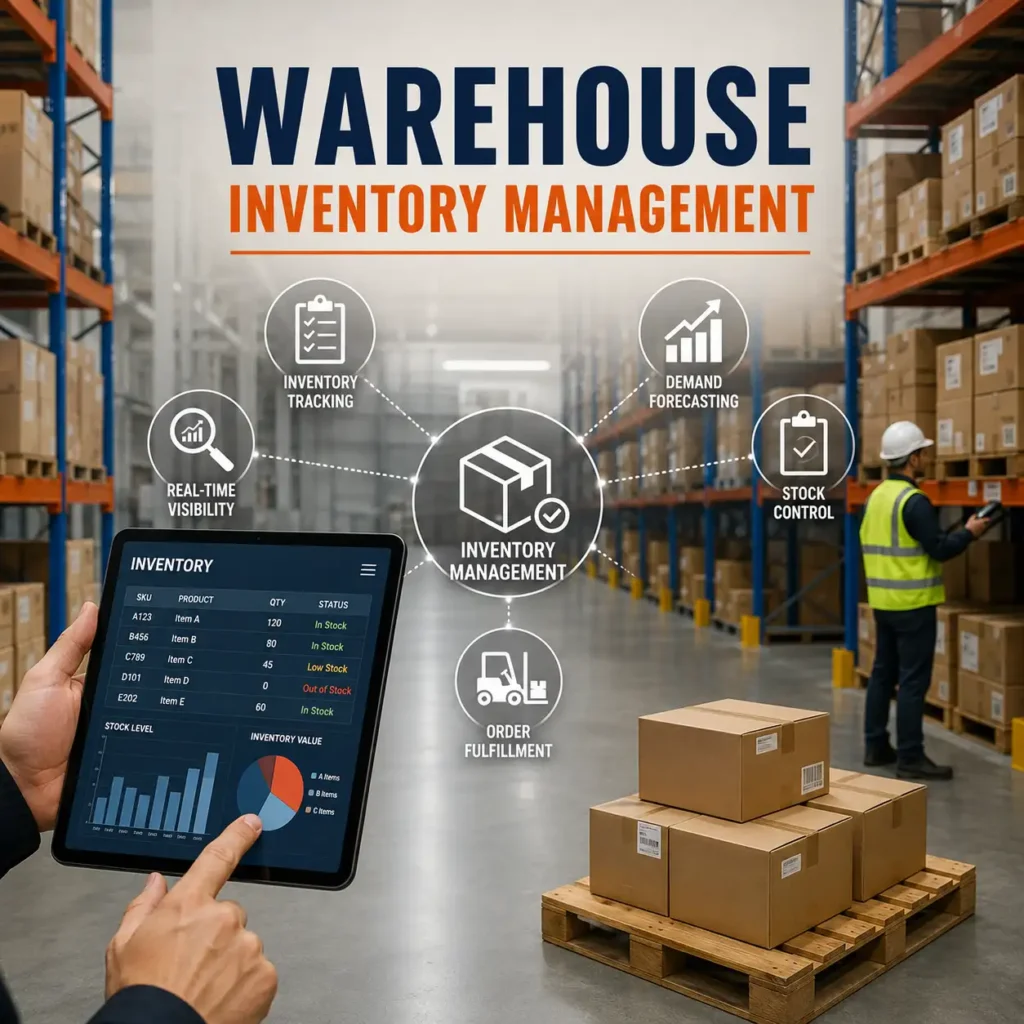
Every product sitting on a warehouse shelf represents money. Managed well, that money circulates, generates revenue, and keeps customers happy. Managed poorly, it ties up capital, inflates costs, and triggers supply chain breakdowns that ripple far beyond the four walls of your facility.
Warehouse inventory management is the backbone of any efficient supply chain operation. Whether you run a small regional distribution center or a large multi-site fulfillment network, how you track, organize, and control your stock determines whether your business thrives or struggles to keep up with demand.
In this guide, you will find a complete breakdown of warehouse inventory management — what it is, why it matters, the challenges businesses commonly face, and the strategies that actually work. If you are looking to improve warehouse inventory control and build a more resilient supply chain, this article covers everything you need to know.
What Is Warehouse Inventory Management?
Warehouse inventory management is the process of overseeing and controlling all goods stored within a warehouse facility. It covers the full lifecycle of stock — from the moment products arrive at the receiving dock to the point they leave as a fulfilled order.
At its core, a warehouse inventory system tracks what you have, where it is located, how much of it is available, and when it needs to be replenished. This information feeds directly into purchasing decisions, production schedules, and order fulfillment processes.
Warehouse inventory management is not simply about counting boxes. It involves:
- Recording stock arrivals during goods receipt
- Assigning products to specific bin locations within the facility
- Monitoring stock levels in real time
- Managing the putaway process so products are stored efficiently
- Coordinating pick and pack operations for outgoing orders
- Conducting regular inventory audits to maintain accuracy
- Forecasting future demand to prevent stockouts and overstock situations
When all of these processes work in harmony, a warehouse operates at peak efficiency. When they break down, the consequences — missed shipments, excess inventory, inaccurate records — compound quickly.
Why Inventory Optimization Matters for Supply Chain Efficiency
The supply chain is only as strong as its weakest link, and for many businesses, that weak link is warehouse inventory control. Poor inventory management creates a cascade of problems: delayed shipments, unhappy customers, inflated carrying costs, and wasted labor.
According to research from the IHL Group, inventory distortion — a combination of stockouts and overstock — costs global retailers over $1.7 trillion annually. That number reflects what happens when businesses fail to align their warehouse stock levels with actual demand.
Inventory optimization directly improves supply chain performance in several ways

Reduced carrying costs
Holding excess inventory ties up working capital and increases storage costs. Optimization keeps stock lean without sacrificing availability.

Fewer stockouts
A stockout does not just mean a lost sale. It damages customer trust and forces buyers to competitors. Proper safety stock calculations and reorder points prevent this from happening.

Faster order fulfillment
When products are accurately located and tracked within the warehouse, pick times drop, error rates fall, and orders ship faster.

Better supplier relationships
Predictable inventory patterns make it easier to plan purchase orders, which strengthens relationships with suppliers and often unlocks better pricing.

Improved cash flow
Stock that moves quickly improves inventory turnover and frees up capital that would otherwise be frozen in slow-moving or dead stock.
Common Warehouse Inventory Challenges
Before exploring solutions, it helps to understand what most warehouses are actually fighting against. These challenges are industry-wide.

Inaccurate Stock Records
Even small discrepancies between physical stock and system records cause significant problems. If your warehouse inventory system shows 200 units but the shelf holds 180, pick errors, unfulfilled orders, and customer complaints follow.
Inventory Shrinkage
Inventory shrinkage — loss caused by damage, theft, administrative error, or supplier shortfalls — is a persistent drain on warehouse profitability. Without tight stock management and regular cycle counting, shrinkage often goes undetected until a physical inventory audit reveals the gap.
Stockouts and Overstock
These two problems sit on opposite ends of the same scale. A stockout leaves customers waiting. Overstock wastes space, increases holding costs, and risks product obsolescence. Balancing the two is one of the central challenges of warehouse inventory management.
Poor Inventory Visibility
When warehouse teams lack real-time inventory tracking, they are always reacting rather than planning. Blind spots in the warehouse lead to double-ordering, misallocated stock, and fulfillment errors.
Inefficient Warehouse Layout
A poorly organized warehouse slows everything down. When products are not slotted according to pick frequency or logical flow, pick and pack times increase, labor costs rise, and error rates climb.
Disconnected Systems
Many businesses run warehouse operations on a patchwork of spreadsheets, legacy software, and manual processes. Without an integrated inventory management system, data silos prevent teams from making informed decisions.
Proven Strategies to Optimize the Supply Chain Through Better Inventory Management
01
Inventory Tracking and Visibility
Real-time inventory tracking is the foundation of effective warehouse inventory management. When you know exactly where every SKU is located and how many units are available at any given moment, decision-making becomes faster and more accurate.
Modern barcode scanning systems and RFID tracking technology have transformed how warehouses maintain visibility. Barcode scanners record stock movements instantly — every goods receipt, putaway, pick, and dispatch is logged in the system as it happens. RFID tracking takes this a step further, enabling automatic identification of items without requiring line-of-sight scanning.
Implementing perpetual inventory methods — where records update continuously with every transaction — eliminates the need to halt operations for full physical counts and gives management a live picture of warehouse efficiency at all times.
02
Demand Forecasting
Knowing what your customers need before they order it is not magic. It is demand forecasting, and it is one of the most powerful tools available to warehouse and supply chain managers.
Effective demand forecasting combines historical sales data, seasonal trends, market signals, and supplier lead times to predict future stock requirements. Businesses that invest in demand forecasting software reduce both stockouts and overstock situations, improve reorder point accuracy, and maintain healthier stock levels across their product range.
For example, a consumer electronics distributor that experiences predictable spikes in Q4 can use historical data to calculate exactly how much safety stock is needed by October — avoiding the dual risk of running dry during peak season or sitting on excess units in January.
03
ABC Inventory Analysis
Not all products deserve equal attention. ABC analysis is a stock classification method that divides inventory into three tiers based on value and turnover rate:
– A items: High-value or high-velocity products that account for roughly 70–80% of total inventory value. These require close monitoring, tight reorder controls, and prime warehouse locations.
– B items: Mid-range products with moderate turnover. Standard monitoring and replenishment processes apply.
– C items: Low-value, slow-moving items. These require less frequent review but should be monitored for dead stock risk.
By applying ABC analysis, warehouse managers allocate labor, space, and attention where it produces the greatest return. A items get the best bin locations — near the dispatch area, at ergonomic pick heights — while C items can be stored in less accessible areas without impacting operational speed.
04
Warehouse Automation
Automation is no longer exclusive to enterprise-scale operations. Businesses of all sizes are integrating warehouse automation tools to reduce manual errors, speed up processes, and lower labor costs.
Key automation applications include:
- Automated storage and retrieval systems (AS/RS) for high-density stock storage
- Conveyor and sortation systems for rapid order processing
- Goods-to-person picking robots that bring products to warehouse workers rather than the other way around
- Automated replenishment alerts triggered when stock falls below the reorder point
- WMS software with workflow automation that assigns tasks dynamically based on warehouse conditions
A mid-sized e-commerce fulfillment center that integrates automated picking systems can process significantly more orders per hour with the same workforce — translating directly into improved warehouse efficiency and reduced cost per shipment.
05
Inventory Audits and Cycle Counting
Annual physical inventory counts are disruptive and increasingly inadequate for fast-moving warehouses. Cycle counting offers a smarter alternative.
Cycle counting involves counting a subset of inventory items on a rotating schedule throughout the year. High-value A items might be counted monthly or weekly, while C items are reviewed quarterly. This approach catches discrepancies early, maintains inventory accuracy without shutting down operations, and reduces the workload of year-end physical counts.
A consistent cycle counting program also helps identify root causes of inventory shrinkage — whether that is a receiving error, picking mistake, or a systems integration gap — so corrective action can be taken before problems compound.
06
Warehouse Layout Optimization
The physical layout of your warehouse has a direct impact on how efficiently inventory moves. A well-designed floor plan reduces travel time, minimizes pick errors, and supports faster order fulfillment.
Key layout principles include:
Slotting by velocity: Place high-frequency A items closest to the dispatch area. Pickers spend less time walking, and throughput increases.
Logical flow from receiving to dispatch: Design the warehouse so goods receipt, putaway, pick and pack, and dispatch follow a natural, uninterrupted path through the facility.
Clear bin location labeling: Every storage location should be uniquely labeled and registered in the warehouse inventory system. Clear labels reduce mispicks and support new staff in navigating the floor efficiently.
Dedicated staging areas: Inbound goods staging and outbound order staging areas prevent congestion and keep product flows separated.
07
Data-Driven Decision Making
Modern WMS software captures enormous volumes of operational data. Businesses that analyze this data — rather than simply collecting it — gain a genuine competitive advantage.
Key metrics to monitor include:
- Inventory turnover ratio: How quickly stock cycles through the warehouse
- Order fulfillment accuracy: Percentage of orders picked and shipped without errors
- Carrying cost per unit: The total cost of holding one unit in the warehouse for a defined period
- Days sales of inventory (DSI): How many days of sales your current stock level represents
- Stockout frequency: How often items are unavailable when orders are placed
By reviewing these metrics regularly, warehouse managers can identify underperforming SKUs, refine reorder points, reallocate storage space, and make smarter purchasing decisions that support long-term supply chain resilience.
08
Supplier Collaboration and Vendor Management
Warehouse inventory is not managed in isolation. Your ability to maintain the right stock levels depends heavily on the reliability of your suppliers and the quality of your vendor relationships.
Strong supplier collaboration practices include:
- Sharing inventory data and demand forecasts with key suppliers so they can plan production accordingly
- Establishing clear lead time commitments and monitoring supplier performance against them
- Developing vendor-managed inventory (VMI) agreements for critical items, where suppliers take responsibility for maintaining agreed stock levels at your facility
- Building backup supplier relationships for high-risk A items so a single supplier disruption does not create a stockout crisis
When suppliers operate as true supply chain partners rather than transactional vendors, both sides benefit from greater predictability, fewer emergency orders, and lower logistics costs.
Benefits of an Optimized Warehouse Inventory System
Investing in proper warehouse inventory management delivers measurable benefits across the business

Reduced operating costs
Leaner stock levels and fewer errors directly reduce carrying costs, labor costs, and the expense of managing returns and corrections.

Improved customer satisfaction
Accurate inventory means orders ship on time and in full. Customer satisfaction scores rise when fulfillment is reliable.

Faster inventory turnover
Optimized stock management reduces the time products spend in the warehouse before reaching the customer, improving cash flow and reducing obsolescence risk.

Scalability
A well-managed warehouse inventory system scales with the business. Adding new product lines, entering new markets, or handling seasonal volume spikes becomes manageable rather than chaotic.

Regulatory compliance
Industries including pharmaceuticals, food and beverage, and electronics often require detailed lot tracking and traceability. An optimized system makes compliance straightforward.

Greater supply chain resilience
Businesses with strong inventory visibility and management practices recover faster from supply chain disruptions — whether caused by supplier delays, demand spikes, or logistical challenges.
Future Trends in Warehouse Inventory Management
The warehouse of the future looks very different from today’s manual operations. Several trends are already reshaping how businesses approach inventory management.
✓ IoT-Connected Warehouses — Internet of Things (IoT) sensors embedded in storage racks, packaging, and equipment feed continuous data into the warehouse inventory system. Temperature-sensitive goods can be monitored without manual checks. Bin locations can self-report when stock falls below a set level.
Frequently Asked Questions About Distribution Channels
Warehouse inventory management is the process of tracking, organizing, and controlling all goods stored in a warehouse. It encompasses stock receipt, storage, replenishment, and order fulfillment, and is supported by systems that provide real-time visibility into stock levels and locations.
Effective warehouse inventory management requires a combination of the right technology, clear processes, and consistent measurement. Key practices include implementing a WMS, using barcode scanning or RFID for real-time tracking, conducting regular cycle counts, applying ABC analysis, and forecasting demand accurately.
The best warehouse inventory system depends on the scale and complexity of your operation. Small businesses often do well with cloud-based inventory management software integrated with their e-commerce platform. Larger operations typically benefit from a full WMS that manages receiving, putaway, picking, packing, and dispatch workflows while integrating with ERP systems.
Reducing inventory errors starts with eliminating manual data entry wherever possible. Barcode scanning at every touchpoint — goods receipt, putaway, picking, dispatch — ensures the system reflects physical reality. Regular cycle counting catches discrepancies early, and staff training ensures processes are followed consistently.
Inventory tracking in a warehouse refers to the real-time monitoring of stock locations, quantities, and movements within the facility. It records every transaction — from goods receipt to order dispatch — so warehouse managers always know exactly what stock they hold and where it is located.
Improving inventory accuracy requires consistent process discipline, reliable scanning technology, regular cycle counts, and a warehouse inventory system that updates in real time. Setting accuracy benchmarks, investigating every discrepancy, and reviewing receiving procedures are also essential steps.
Inventory management software focuses primarily on tracking stock levels, recording transactions, and generating replenishment alerts. A warehouse management system (WMS) goes further — it manages the physical flow of goods through the facility, optimizes pick paths, directs putaway, coordinates labor, and integrates with automated equipment. Many modern WMS platforms include full inventory management functionality, making the distinction increasingly one of scope and complexity rather than category.
Conclusion
Warehouse inventory management is not a back-office function — it is a strategic driver of supply chain performance. Businesses that treat it as such, investing in the right systems, processes, and people, consistently outperform competitors who rely on reactive, manual approaches.
The strategies covered in this guide — real-time inventory tracking, demand forecasting, ABC analysis, warehouse automation, cycle counting, layout optimization, data-driven decision making, and supplier collaboration — are not theoretical. They are the practices that leading warehouse operators use every day to reduce costs, improve service levels, and build supply chains that hold up under pressure.
Start with your biggest pain point. If inventory accuracy is your challenge, implement barcode scanning and cycle counting first. If stockouts are costing you customers, focus on demand forecasting and reorder point optimization. If your warehouse efficiency is lagging, take a hard look at your layout and slotting strategy.
Wherever you start, the direction is the same: better warehouse inventory management leads to a stronger supply chain, a healthier business, and more satisfied customers. The investment pays for itself.
Ready to take your warehouse inventory management to the next level? Evaluate your current systems, identify your gaps, and build a roadmap toward a smarter, leaner, and more responsive warehouse operation.