

Order Picking Methods: The Complete Guide to Choosing the Right Strategy
Confused about order picking methods? Compare batch, zone, wave, cluster & single-order picking, see which fits your warehouse, and learn how to boost accuracy.
Order picking is the single most labor-intensive task in any warehouse. Multiple industry studies put picking at roughly 50–60% of total warehouse operating labor — more than receiving, put-away, packing, and shipping combined. That makes it the biggest lever you have for cutting cost, speeding up fulfillment, and reducing errors.
The problem is that most warehouses default to whatever method they started with, without ever checking if it still fits their order volume, SKU mix, or floor layout. This guide breaks down every major order picking method, compares them side by side, and walks through how to choose — and adjust — the right one for your operation.
What Is Order Picking?
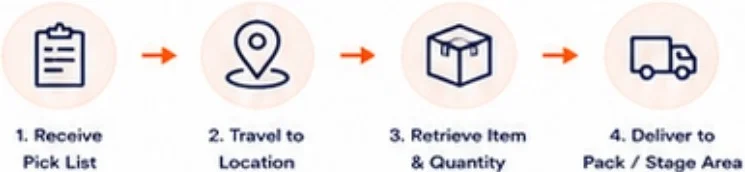
Order picking is the process of retrieving specific items from storage locations in a warehouse to fulfill a customer or internal order. It typically involves four steps: receiving the pick list, traveling to the storage location, retrieving the correct item and quantity, and delivering it to a packing or staging area.
Because picking eats up more labor hours than any other warehouse function, even small inefficiencies compound fast. A picker who walks an extra 30 seconds per order across 500 orders a day loses over four hours of productivity daily — before a single item is packed or shipped.
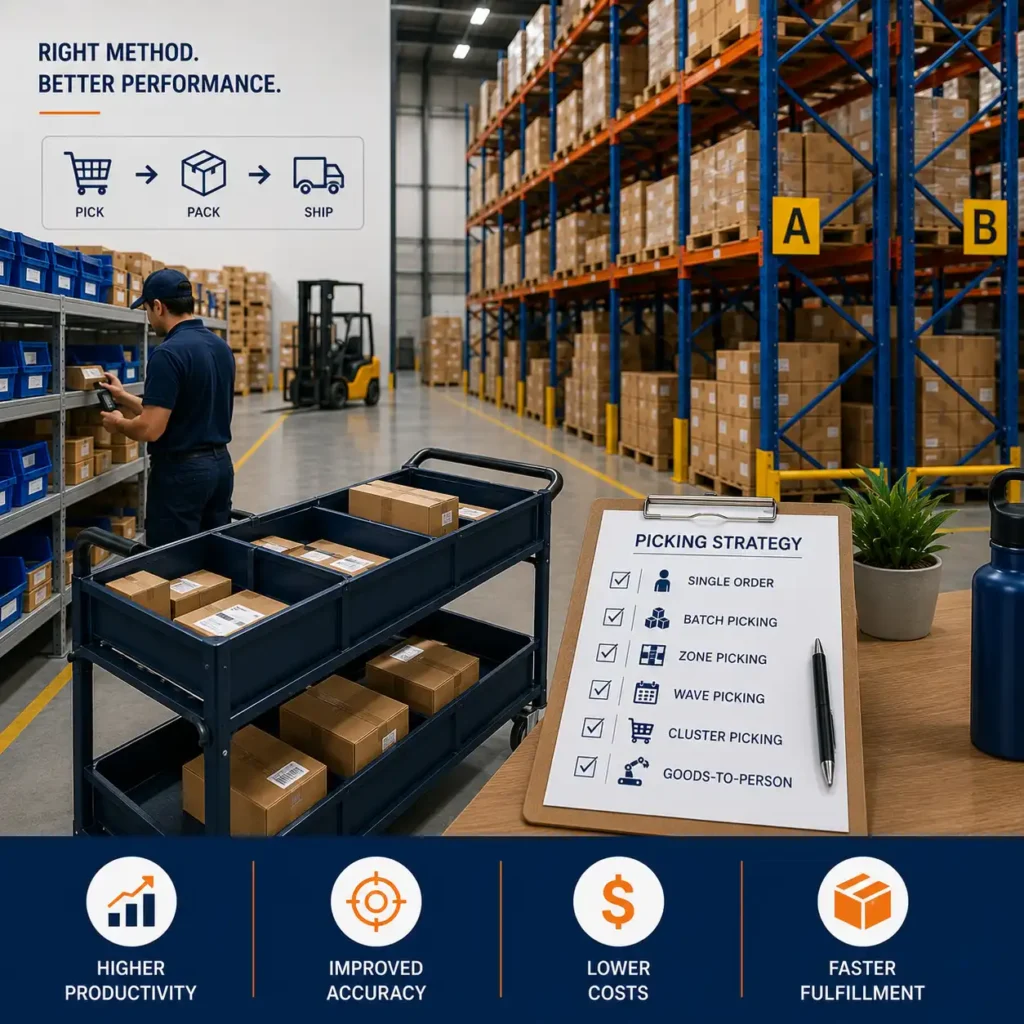
Types of Order Picking Methods
1. Single Order Picking (Discrete Picking)

Single order picking — also called discrete picking — is the simplest method: one picker collects all the items for one order, start to finish, before moving to the next.
Best for: Low order volumes, businesses just starting out, or operations with highly variable, custom orders.
PROS
- Simple to manage, no software required
- Low error rate since one person owns the whole order
- Easy to train new staff on
CONS
- Highest travel time per order
- Doesn't scale well as order volume grows
2. Batch Picking

Batch picking groups multiple orders that share common items into a single pick run. Instead of walking the warehouse once per order, a picker collects the total quantity needed for several orders in one trip, then sorts items into individual orders at a later stage.
Best for: High-volume operations with many small orders that share similar SKUs — a common pattern in e-commerce.
PROS
- Significantly cuts travel time versus single order picking
- Works well with simple pick carts — no heavy automation required
CONS
- Requires an accurate sorting step after picking, which adds a point of potential error
- Less effective when orders have little SKU overlap
3. Zone Picking

Zone picking divides the warehouse into fixed zones, with each picker responsible only for items located in their assigned zone. An order might pass through several zones before it’s complete, either sequentially (pick-and-pass) or simultaneously with the pieces consolidated afterward.
Best for: Large warehouses with a wide SKU range and multiple pickers working at once.
PROS
- Pickers become highly efficient in a smaller, familiar area
- Reduces overall walking distance across the warehouse
- Scales well with headcount
CONS
- Orders spanning multiple zones require a consolidation step, which can create bottlenecks
- Needs clear zone boundaries and a logical racking layout to work well
4. Wave Picking

Wave picking releases groups of orders for picking at scheduled times (“waves”) throughout the day, timed to align with shipping cutoffs, staffing shifts, or carrier pickups.
Best for: Operations with tight shipping deadlines, multiple carriers, or fluctuating order volumes throughout the day.
PROS
- Synchronizes picking with packing and shipping, reducing idle dock time
- Better labor planning — you know exactly when picking demand peaks
- Can be combined with batch or zone picking for added efficiency
CONS
- Requires warehouse management software (WMS) to plan and trigger waves
- Poorly timed waves can create picker downtime between runs
5. Cluster Picking

Cluster picking is a variation of batch picking where a picker uses a multi-compartment cart or trolley to pick several orders simultaneously in a single pass, placing items directly into the correct compartment as they go — skipping the separate sorting step batch picking requires.
Best for: Mid-sized operations wanting the speed of batch picking without a dedicated sorting stage.
PROS
- Combines picking and sorting into one step
- Reduces handling and mis-ship risk versus standard batch picking
CONS
- Cart capacity limits how many orders can be clustered at once
- Less efficient for large, bulky items
6. Goods-to-Person (GTP) Picking

Instead of sending pickers to the inventory, GTP systems use automation — conveyors, shuttles, or robotic storage units — to bring inventory directly to a stationary picker.
Best for: High-volume, high-SKU operations with the budget for automation investment.
PROS
- Eliminates picker travel time almost entirely
- Very high throughput and accuracy
- Reduces labor dependency for peak seasons
CONS
- High upfront capital cost
- Longer implementation timeline; not practical for smaller operations
7. Zone-Batch-Wave (Hybrid Picking)

Larger operations often combine all three core strategies: zones for spatial efficiency, batches for reduced travel, and waves for shipping alignment. This hybrid approach is common in high-volume distribution centers where a single method alone can’t handle the complexity.
Best for: Large distribution centers with high SKU counts, multiple shipping windows, and dedicated WMS support.
Comparison Table: Which Order Picking Method Fits Your Warehouse?
Method
Order Volume
SKU Overlap Needed
Tech Requirement
Best Fit
Single/Discrete
Low
None
None
Startups, custom orders
Batch
Medium–High
High
Low (carts)
E-commerce, similar SKUs
Zone
High
Any
Medium
Large warehouses, multiple pickers
Wave
High
Any
WMS required
Multiple shipping deadlines
Cluster
Medium
High
Low–Medium
Mid-size, order accuracy focus
Goods-to-Person
Very High
Any
High (automation)
Large-scale, high-throughput ops
Zone-Batch-Wave
Very High
Any
WMS required
Enterprise distribution centers
How to Choose the Right Order Picking Method
There’s no universal “best” method — the right choice depends on a handful of specific factors in your operation:
- Order volume
Low-volume operations rarely benefit from complex methods like wave or zone picking; the coordination overhead isn’t worth it.
- SKU variety and overlap
If most orders share the same handful of items, batch or cluster picking will save significant time. If every order is different, stick with single-order picking.
- Warehouse size and layout
Larger footprints benefit more from zone picking, since it limits how far any one picker has to travel.
- Shipping deadlines
Multiple daily carrier cutoffs make wave picking worth the software investment.
- Budget for technology
WMS-driven methods (wave, zone-batch-wave, GTP) require software or automation spend that smaller operations may not be ready for.
Most warehouses don’t pick one method and stay there forever — as order volume grows, it’s common to move from single-order picking, to batch picking, to a zone or wave hybrid as complexity increases.
The Overlooked Factor: Racking and Shelving Layout
Almost every guide to order picking methods skips the one thing that determines whether any of these strategies actually work: how your racking and shelving is laid out.
Zone picking only saves time if zones are drawn around a logical, well-organized racking layout — not an ad hoc mix of pallet racking and shelving bolted together over the years. Batch and cluster picking depend on fast-moving SKUs being placed on easily accessible shelving, not buried in deep-reach racking meant for bulk pallets. And wave picking’s entire premise — hitting scheduled shipping windows — falls apart if pickers are wasting time navigating a poorly planned aisle structure.
Before investing in a new picking method or WMS, it’s worth auditing whether your warehouse racking system and shelving layout actually support it. Selective pallet racking suits fast-moving, single-order picking. Long span shelving works better for high-SKU, low-weight batch picking. A mix of both — designed around your actual pick paths — is usually what separates warehouses that hit their throughput targets from ones that don’t.
Frequently Asked Questions
Single-order (discrete) picking is usually best for small warehouses with low order volume, since it requires no special software and is easy for a small team to manage.
Batch or cluster picking tends to work best for e-commerce, since online orders often contain overlapping, fast-moving SKUs that benefit from picking multiple orders in a single trip.
The three biggest levers are: reducing picker travel distance through zone picking or better racking layout, batching orders with overlapping SKUs, and placing fast-moving items in easily accessible locations near the front of the pick path.
Cluster picking and goods-to-person systems reduce accuracy risk by eliminating the manual sorting step. Barcode or RFID scanning at the point of pick also significantly cuts mis-picks regardless of which method you use.
Yes — most high-volume warehouses use a hybrid approach, such as zone-batch-wave picking, combining the strengths of each method rather than relying on just one.
Final Thoughts
Choosing an order picking method isn’t a one-time decision — it’s something worth revisiting as your order volume, SKU count, and shipping demands change. Start with the simplest method that fits your current volume, and layer in batching, zoning, or waves as complexity grows.
And before you invest in new software or automation to fix a picking problem, take a hard look at your racking and shelving layout first. In a lot of warehouses, that’s the cheaper fix — and the one that makes every picking method on this list work better.
Looking to redesign your warehouse layout for faster, more accurate order picking? Talk to RackPro Shelving about racking and shelving systems built around your actual pick paths — not just your storage capacity.